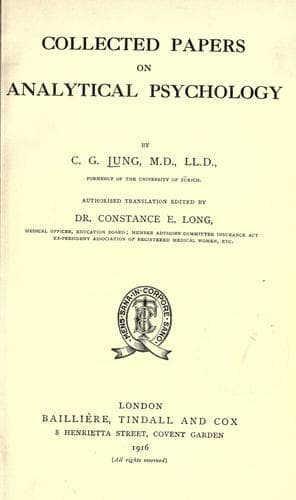
Collected Papers on Analytical PsychologyJung, C. G. (Carl Gustav)
Science
Collected Papers on Analytical Psychology
Jung, C. G. (Carl Gustav)
Psychoanalysis
the motor speech route; thus all the inflowing associations which at
once unite with any new sense impression are repressed. The further
psychological mechanism permits of only two possible explanations:
(1) The admission of the sense impression is received unconsciously
(because of the increase of threshold stimulus), in the perceptive
centre just below the threshold of consciousness, and consequently is
not incorporated in the attention and conducted back to the speech
route. It only reaches verbal expression through the intervention of the
nearest associations, in our case through the dialect expression[23] for
the object. (2) The sense impression is perceived consciously, but at
the moment of its entrance into the speech route it reaches a territory
whose excitability is diminished by the dispersion of attention. At
this place the dialect word is substituted by association for the motor
speech image, and it is uttered as such. In either case it is certain
that it is the acoustic dispersed attention which fails to correct
the error. Which of the two explanations is correct cannot be proved
in this case; probably both approach the truth, for the dispersion of
attention seems to be general, and in each case concerns more than one
of the centres engaged in the act of reading aloud. In our case this
phenomenon has a special value, for we have here a quite elementary
automatic phenomenon. It may be called hysterical in so far as in this
concrete case a state of exhaustion and intoxication, with its parallel
manifestations, can be excluded. A healthy person only exceptionally
allows himself to be so engaged by an object that he fails to correct
the errors of a dispersed attention--those of the kind described. The
frequency of these occurrences in the patient point to a considerable
limitation of the field of consciousness, in so far as she can only
master a relative minimum of elementary sensations flowing in at the
same time. If we wish to describe more exactly the psychological state
of the "psychic shady side," we might call it either a sleeping or a
dream-state, according as passivity or activity predominated. There
is, at all events, a pathological dream-state of very rudimentary
extension and intensity and its genesis is spontaneous; dream-states
arising spontaneously, with the production of automatisms, are generally
regarded as hysterical on the whole. It must be pointed out that these
instances of misreading occurred frequently in our subject, and that the
term hysterical is employed in this sense; so far as we know, it is only
on a foundation of hysterical constitution that spontaneous states of
partial sleep or dreams occur frequently.
Public-domain text, read in full here on John Shaqi.
Reviews
Reviews
No reviews yet
Be the first to share your thoughts on this work.
Join the Discussion
Join the discussion
Sign in to leave a comment or review.
Sign InorCreate an account