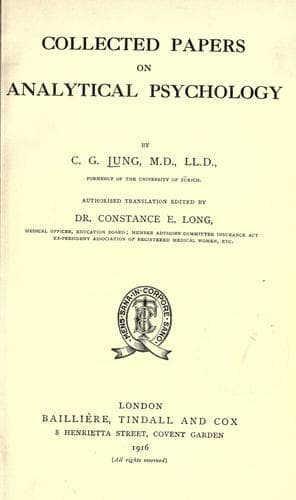
Collected Papers on Analytical PsychologyJung, C. G. (Carl Gustav)
Science
Collected Papers on Analytical Psychology
Jung, C. G. (Carl Gustav)
Psychoanalysis
The objection that there is simulation in automatic table-turning may
well be given up, when one considers the phenomenon of thought-reading
from the purposeful tremors which the patient offered in such plenitude.
Rapid, conscious thought-reading demands at the least an extraordinary
degree of practice, which it has been shown the patient did not
possess. By means of the purposeful tremors whole conversations can
be carried on, as in our case. In the same way the suggestibility
of the subconscious can be proved objectively if, for instance, the
experimenter with his hand on the table desires that the hand of
the medium should no longer be able to move the table or the glass;
contrary to all expectation and to the liveliest astonishment of
the subject, the table will immediately remain immovable. Naturally
any other desired suggestions can be realised, provided they do not
overstep by their innervations the region of partial hypnosis; this
proves at the same time the limited nature of the hypnosis. Suggestions
for the legs and the other arm will thus not be obeyed. Table-turning
was not an automatism which belonged exclusively to the patient's
semi-somnambulism: on the contrary, it occurred in the most pronounced
form in the waking state, and in most cases then passed over into
semi-somnambulism, the appearance of this being generally announced by
hallucinations, as it was at the first sitting.
2. _Automatic Writing._--A second automatic phenomenon, which at
the outset corresponds to a higher degree of partial hypnosis, is
automatic writing. It is, according to my experience, much rarer and
more difficult to produce than table-turning. As in table-turning,
it is again a matter of a primary suggestion, to the conscious when
sensibility is retained, to the unconscious when it is obliterated.
The suggestion is, however, not a simple one, for it already bears in
itself an intellectual element. "To write" means "to write something."
This special element of the suggestion, which extends beyond the
merely motor, often conditions a certain perplexity on the part of the
subject, giving rise to slight contrary suggestions which hinder the
appearance of the automatisms. I have observed in a few cases that the
suggestion is realised, despite its relative venturesomeness (_e.g._
one directed towards the waking consciousness of a so-called normal
person). However, it takes place in a peculiar way; it first displaces
the purely motor part of the central system concerned in hypnosis, and
the deeper hypnosis is then reached by auto-suggestion from the motor
phenomenon, analogous to the procedure in table-turning described above.
The subject,[37] who has a pencil in his hand, is purposely engaged in
conversation whilst his attention is diverted from the writing. The hand
begins to make movements, beginning with many upward strokes and zigzag
lines, or a simple line is made. Occasionally it happens that the pencil
does not touch the paper, but writes in the air.
Public-domain text, read in full here on John Shaqi.
Reviews
Reviews
No reviews yet
Be the first to share your thoughts on this work.
Elsewhere in the archive
Join the Discussion
Join the discussion
Sign in to leave a comment or review.
Sign InorCreate an account