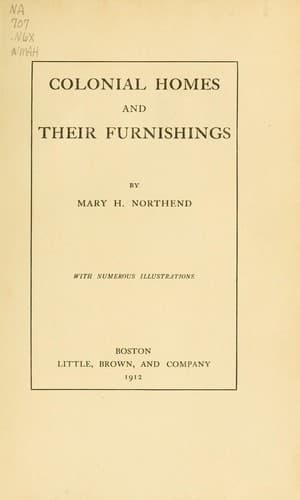
Colonial Homes and Their FurnishingsNorthend, Mary Harrod
History
Colonial Homes and Their Furnishings
Northend, Mary Harrod
Architecture, Colonial; Furniture -- United States
The colonists understood harmony in home decoration, and their wall
hangings as well as their furniture were carefully chosen. They
purchased papers to suit their apartments, and the colors were selected
with a view to the best effect, so that the soft white of the woodwork
might be in keeping with their pictorial value. Consistency is the
keynote of the colonial interior, and it is this feature that has given
to homes of this type that touch of distinction that no other period of
architecture possesses.
[Illustration: PLATE XXI.--Venetian paper in Wheelwright House,
Newburyport.]
The old wall papers all represent foreign scenes, those of France and
England predominating, the latter in a greater degree than the former,
though the French papers were more highly finished than the English.
When the colonist became prosperous, and the newest fashions of the
motherland were eagerly copied, wall papers of both types were imported;
many of these are still preserved, showing shadings done by hand with
the utmost care, and colorings of lovely reds, blues, and browns, all
produced by the use of from fifteen to twenty sets of blocks.
[Illustration: PLATE XXII.--Roman Ruins paper, Lee Mansion, Marblehead.]
One of the most exquisite of French papers is shown in the Knapp house
at Newburyport, Massachusetts, built by a Revolutionary hero, at the
time of the erection of the Lee Mansion at Marblehead. This paper is
thought to have been fashioned in the first quarter of the nineteenth
century, and in type it is like that found on the hall of the
"Hermitage," Andrew Jackson's residence near Nashville, Tennessee. It is
produced in wonderful shades of soft green, red, peacock blue, and
white, all undimmed by time, and it represents scenes from Fénelon's
"Adventure of Telemachus," a favorite novelty in Paris in 1820.
[Illustration: PLATE XXIII.--Adventures of Telemachus paper, Nymphs
Swinging.]
Other fine examples of this type of paper, which have never been hung,
are still preserved in the home of Major George Whipple at Salem, having
been imported about 1800. These show different scenes, including
representations of gateways and fountains, with people in the
foreground.
Natural scenes were favorite themes with many designers, one such
example being a Venetian scheme still shown on the walls of the
Wheelwright house in Newburyport, a fine, colonial dwelling, built a
hundred years ago by an ancestor of William Wheelwright, whose energies
resulted in the first railroad over the Andes. This paper is found in
the drawing-room, and another, illustrative of a chariot race, is shown
in one of the chambers.
Public-domain text, read in full here on John Shaqi.
Reviews
Reviews
No reviews yet
Be the first to share your thoughts on this work.
Elsewhere in the archive
Join the Discussion
Join the discussion
Sign in to leave a comment or review.
Sign InorCreate an account