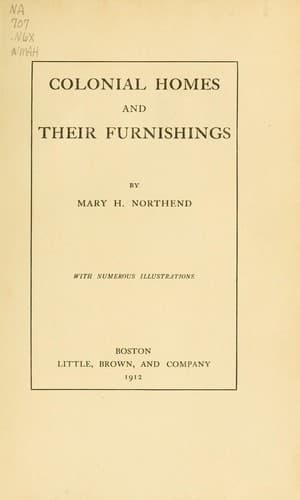
Colonial Homes and Their FurnishingsNorthend, Mary Harrod
History
Colonial Homes and Their Furnishings
Northend, Mary Harrod
Architecture, Colonial; Furniture -- United States
The most common and popular chairs of the eighteenth century were those
of the Windsor type, manufactured in this country as early as 1725, and
deriving their name from the town in England where they originated. The
story of their origin is most interesting. The reigning George of that
day, the second of his name, saw in a shepherd's cottage a chair which
he greatly admired. He bought it to use as a model, thus setting the
stamp of kingly approval on this type, and bringing it into immediate
favor. It is not related what color he had his chairs painted, but
the general coloring employed was either black or dark green, though
some chairs were not painted at all. The finish of the back of this type
was varied to suit different fancies, some few having a comblike
extension on top as a head-rest, while others had a curved or bowlike
horizontal top piece, like a fan. These types originated the names comb
back and fan back, by which Windsor chairs of these types are known.
American manufacturers in general copied the English styles, though they
also developed several variations. Many American Windsors, particularly
the fan backs, are equipped with rockers, the date of their manufacture
coming after the Revolution.
[Illustration: PLATE XXVI.--Chippendale Arm Chair, showing straight,
square legs; Chippendale Chair; Chippendale, one of a set of six,
showing Rosette design; Chippendale Arm Chair with Cabriole legs, Ball
and Claw feet.]
But Windsor chairs, popular and fine as they were, by no means were the
best type developed in this century, for this period marked a great
change in the history of cabinet-making, resulting in the development of
wonderful designs, exquisitely blended and finished. First on the list
of the new master craftsmen was Chippendale, who in 1753 issued his
first book of designs, and whose models were given first consideration
for more than thirty years. Then, in 1789, followed Hepplewhite, and two
years later came Sheraton, while lesser lights, such as the Brothers
Adam, Manwaring, Ince, and Mayhew, all contributed their share to the
betterment of chair manufacture.
The chair seems to have been Chippendale's favorite piece of furniture,
and in its design he has blended the finest points in French, Dutch, and
Chinese patterns. His first chairs showed Dutch influence, and for these
he used the cabriole leg, greatly improving its curving, with the Dutch
or ball-and-claw foot, the latter more frequently than the former. His
chair seats were broad and flat, and in his backs he disregarded the
usual Dutch types, his uprights generally joining the top at an angle,
and his top piece being usually bow-shaped. His backs were a little
broader at the top than at the bottom, and he used the central splat
carved and pierced.
Public-domain text, read in full here on John Shaqi.
Reviews
Reviews
No reviews yet
Be the first to share your thoughts on this work.
Elsewhere in the archive
Join the Discussion
Join the discussion
Sign in to leave a comment or review.
Sign InorCreate an account