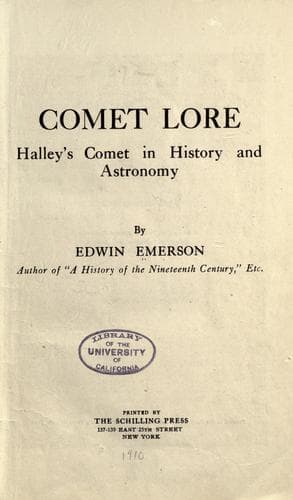
Comet Lore: Halley's Comet in History and AstronomyEmerson, Edwin
History
Comet Lore: Halley's Comet in History and Astronomy
Emerson, Edwin
Comets; Halley's comet
All eyes were distended with horror when it was seen that the horizon
was lighting up with tiny violet flames as from a vast fire.
An instant afterward, the Comet diminished in brilliancy. This was
apparently because the Comet, upon touching the atmosphere of our
Earth, had come within the penumbra of our planet and had lost part of
its reflected light coming from the Sun. But in reality this apparent
extinction was the effect of contrast. When the less dazzled eyes of
the awestruck, human spectators had grown used to this new light, it
appeared almost as intense as at first, but paler, more sinister and
sepulchral.
Never before had the Earth been lit up with so sickly a light.
The drouth of the air became intolerable. Heat, as from a huge burning
oven, came from above. A horrible stench of burning sulphur—due, no
doubt, to electrified ozone—poisoned the atmosphere.
All the people then saw that their time had come. Many-thousand-throated
cries rent the air. “The World is burning. We are on fire!” they cried.
All the horizon, in fact, was now lit up with flame, forming a crown
of blue light. It was, indeed, as had been foreseen by scientists, the
oxide of carbon igniting in the air and producing anhydrid of carbon.
Clearly, too, hydrogen from the Comet combined with it.
On a sudden, as the people were gazing terrified, motionless, mute,
holding their breath, and scared out of their wits, the vault of Heaven
seemed to be rent asunder from the zenith to the horizon. Through the
gaping breach there seemed to appear the huge red mouth of a dragon,
belching forth sheaves of sputtering green flames.
The glare of the atmosphere was so fierce that those who had not
already hidden themselves in the cellars of their houses, now all
rushed helter-skelter to the nearest underground openings, be they
subway steps, cellar doors or sewer manholes. Thousands were crushed or
maimed during this mad stampede, while many others, frantic from fright
and stricken with the heat, fell dead from apoplexy.
All reasoning powers seemed to have ceased. Among those cowering in
dark cellars and subterranean passages below, there was nothing but
silence, begot by dull resignation and stupor.
Of all this panic-stricken multitude, only the astronomers had remained
at their posts in the Observatories, making unceasing observations of
this great astronomic phenomenon. They were the only eye-witnesses of
the impending collision.
Their calculations had been that the terrestrial globe would penetrate
into the core of the Comet, as a cannon ball might into a cloud. From
the first contact of the extreme atmospheric zones of the Earth and of
the Comet, they had figured, the transit would last four hours and a
half.
It was easy to compute, since the Comet, being about fifty times as
large as the Earth, was to be pierced, not in its centre, but at
one-quarter of the distance from the centre, with a velocity of 173,000
kilometers an hour.
Public-domain text, read in full here on John Shaqi.
Reviews
Reviews
No reviews yet
Be the first to share your thoughts on this work.
Join the Discussion
Join the discussion
Sign in to leave a comment or review.
Sign InorCreate an account