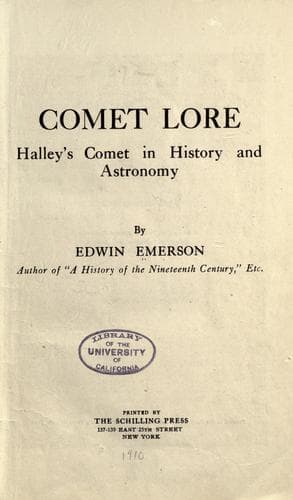
Comet Lore: Halley's Comet in History and AstronomyEmerson, Edwin
History
Comet Lore: Halley's Comet in History and Astronomy
Emerson, Edwin
Comets; Halley's comet
Camille Flammarion, the French astronomer, in his story, “The End
of the World,” gives this graphic description of the results of a
collision between a Comet and our Earth:
In Paris, London, Rome, Berlin, St. Petersburg, Constantinople, New
York and Chicago—in all the great capitals of the world, in all the
cities, in all the villages—the frightened people wandered out of
doors, as one sees ants run about when their ant-hills are disturbed.
All the affairs of every-day life were forgotten.
All human projects were at a standstill. People seemed to have
lost interest in all their affairs. They were in a state of
demoralization—a dejection more abject even than that which is
produced by sea-sickness.
All places of worship had been crowded on that memorable day when it
was seen that a collision with a Comet had become inevitable.
In Paris the crowds in the churches were so great that people could
no longer get near Notre Dame, the Madeleine and the other churches.
Within the churches, vast congregations of worshippers were on their
knees praying to God on High. The churches rang with the sounds of
supplication, but no other sound was heard. The great church organs and
the bells in the steeples were hushed.
In the streets, on the avenues, in the public squares, there was the
same dread silence. Nothing was bought or sold. No newspapers were
hawked about.
The only vehicles seen on the streets were funeral hearses carrying to
the cemeteries the bodies of the first victims of the Comet. Of these
there were already many. They were people who had died from fright and
from heart disease.
With what anxiety everyone waited for the night!
Never, perhaps, was there a more beautiful sunset. Never a clearer sky.
The sun seemed to dip into a sea of red and gold.
The huge red ball of the sun sank majestically to the horizon. But the
stars did not appear. Night did not come.
To the solar day succeeded a new day, the daylight of the Comet. Its
intense light resembled that of an Aurora Borealis, but more vivid,
coming from a great incandescent spot, which had not been visible
during the day because it was below the horizon, but which would
certainly have rivalled the splendour of the Sun.
This luminous spot rose in the East almost at the same time as the full
Moon. The two luminous bodies rose together, side by side. As they
rose, the light of the Moon seemed to pale, but the head of the Comet
increased in splendour with the disappearance of the Sun below the
western horizon.
Now, after nightfall, the Comet dominated the world—a scarlet-red ball
with jets of yellow and green flame which seemed to flutter like fiery
wings.
To the terrified people it seemed like a giant of fire taking
possession of all Heaven and Earth.
Already the outermost jets of flame had reached the Moon. From one
instant to the next the flaming rays would descend upon the Earth.
Public-domain text, read in full here on John Shaqi.
Reviews
Reviews
No reviews yet
Be the first to share your thoughts on this work.
Join the Discussion
Join the discussion
Sign in to leave a comment or review.
Sign InorCreate an account