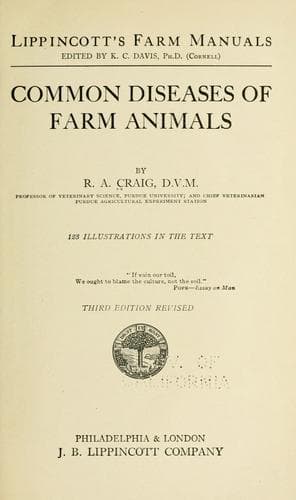
Common Diseases of Farm AnimalsCraig, Robert Alexander
Science
Common Diseases of Farm Animals
Craig, Robert Alexander
Veterinary medicine
Ewes frequently suffer from too close confinement during late winter. Sows
are often subject to the most unhygienic conditions. This is shown in the
heavy death-rate in sows and pigs. During the late winter and early spring
the conditions may be such as not to permit of exercise. Stormy, snowy,
muddy weather is common at this season of the year. Persons caring for ewes
and sows should see that they take sufficient exercise. It may be necessary
to drive them about for a short time each day. At such times it may be
advisable to give them a laxative dose of oil, or give a laxative with the
feed. When there is any indication of constipation, this should be
practised.
Pregnant animals should be fed carefully. We may feed animals that are not
in this condition in a careless fashion, but if pregnant, over-feeding, the
feeding of a fattening ration, or spoiled feed, and sudden changes in the
feed can not be practised with any degree of safety. A bulky ration of dry
feed and drinking impure, or too little, water may cause constipation,
acute indigestion and abortion. The ration fed should contain the necessary
inorganic and organic elements for the building up of the body tissues of
the foetus.
At the end of the parturition period, separate quarters should be provided.
The mare or cow should be given a comfortable clean stall away from the
other animals. The ewe should be provided with a warm room if the weather
is cold. It is always best to give the sow a separate pen that is dry and
clean, and away from the other animals. All danger from injury to the
mother and young should be guarded against.
ABORTION.--The expulsion of the foetus at any time during the period of
gestation, when it is not sufficiently developed to live independently of
the mother, is termed abortion. Abortion may be either _accidental_ or
_infectious_. Accidental abortion is more commonly met with in the mare and
sow than the infectious form. In ruminants the opposite holds true.
_The causes of accidental abortion_ are faulty methods of feeding and care.
Injuries, acute indigestion, mouldy, spoiled feeds, chilling resulting from
exposure and drinking ice-cold water, nervousness brought on by fright, or
excitement and general diseases are the common causes of abortion.
_Infectious abortion_ is most common in cows. Other domestic animals that
may be affected are the mare, sow and ewe.
_It is caused_ by a specific germ. The _Bacillus abortus_ of Bang is the
cause of abortion in cows, but the specific germ that produces abortion in
other species of animals has not been proven. In this country, Keer, Good,
Giltner and others have proven that the Bang bacillus of abortion is
infectious for other species of animals, and outbreaks of this disease have
been said to occur among breeding ewes pastured and fed on infected
premises. Its infectiousness for the females of other species has never
been proven in natural outbreaks.
Public-domain text, read in full here on John Shaqi.
Reviews
Reviews
No reviews yet
Be the first to share your thoughts on this work.
Join the Discussion
Join the discussion
Sign in to leave a comment or review.
Sign InorCreate an account