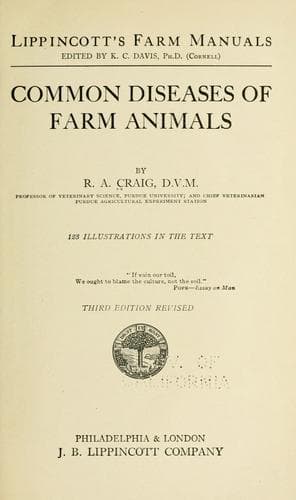
Common Diseases of Farm AnimalsCraig, Robert Alexander
Science
Common Diseases of Farm Animals
Craig, Robert Alexander
Veterinary medicine
The relative size of the foetus to the inlet of the pelvic cavity and its
position are the most important factors for the veterinarian and stockman
to consider (Fig. 18). On leaving the womb, the foetus passes into the
vagina and vulva. This portion of the maternal passages is situated in the
pelvic cavity which continues the abdominal cavity posteriorly. The pelvic
walls are formed by bones and ligaments that are covered by heavy muscles.
As previously mentioned, the ligaments and muscles relax toward the end of
pregnancy in order to prepare the way for the passage of the foetus. Before
entering the pelvis it is necessary for the foetus to be forced through the
inlet to this cavity. This is the most difficult part of the birth, as the
bones that form the framework of the pelvis completely enclose the entrance
to it. It is only in the young mother that the pelvic bones give way
slightly to the pressure on them by the foetus. It can be readily
understood, that when the young is large in proportion to the diameter of
the pelvic inlet, it is difficult for it to pass through. This occurs when
mothers belonging to a small breed, are impregnated by a sire belonging to
a large breed of animals. It may also occur if the mother is fed too
fattening a ration and not permitted sufficient exercise.
The part of the foetus that presents itself for entrance into the pelvic
cavity and its position are of the greatest importance in giving birth to
the young. Either end of the foetus, or its middle portion may be presented
for entrance. The _anterior_ and _posterior presentations_ may be modified
by the position that the foetus assumes. It may be in a position that
places the back or vertebrae opposite the upper portion of the inlet, or
the floor or sides of the pelvic cavity. These positions may be modified by
the position of one or both limbs, or the head and neck being directed
forwards instead of backwards. In the _transverse presentations_, the back,
or the feet and abdomen of the foetus may present themselves for entrance
to the pelvic cavity. These presentations may show three positions each.
The head may be opposite the upper walls of the inlet, the foetus assuming
a dog-sitting position, or it may lie on either side.
In order to overcome the friction between the foetus and the wall of the
maternal passages, these parts are lubricated by the fluids that escape
from the "water bags." If birth is prolonged and the passages become dry,
birth is retarded. The hair offers some resistance in a posterior
presentation. Young mares that become hysterical have abnormal labor pains
that seem to hold the foetus in the womb instead of expelling it.
Public-domain text, read in full here on John Shaqi.
Reviews
Reviews
No reviews yet
Be the first to share your thoughts on this work.
Elsewhere in the archive
Join the Discussion
Join the discussion
Sign in to leave a comment or review.
Sign InorCreate an account