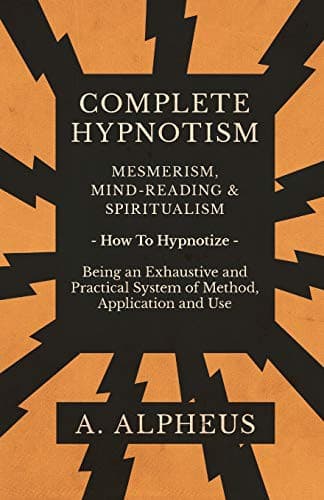
Complete Hypnotism, Mesmerism, Mind-Reading and Spiritualism: How to Hypnotize: Being an Exhaustive and Practical System of Method, Application, and UseAlpheus, A.
History
Complete Hypnotism, Mesmerism, Mind-Reading and Spiritualism: How to Hypnotize: Being an Exhaustive and Practical System of Method, Application, and Use
Alpheus, A.
Hypnotism; Mesmerism; Spiritualism; Telepathy
Again, there is absolutely no well authenticated case of crime
committed by a person under hypnotic influence. There have been several
cases reported, and one woman in Paris who aided in a murder was
released on her plea of irresponsibility because she had been
hypnotized. In none of these cases, however, was there any really
satisfactory evidence that hypnotism existed. In all the cases reported
there seemed to be no doubt of the weak character and predisposition to
crime. In another class of cases, namely those of criminal assault upon
girls and women, the only evidence ever adduced that the injured person
was hypnotized was the statement of that person, which cannot really be
called evidence at all.
The fact is, a weak character can be tempted and brought under virtual
control much more easily by ordinary means than by hypnotism. The man
who “overpersuades” a business man to endorse a note uses no hypnotic
influence. He is merely making a clever play upon the man’s vanity,
egotism, or good nature.
A profound study of the hypnotic state, such as has been made by Prof.
William James, of Harvard College, the great authority on psychical
phenomena and president of the Psychic Research Society, leads to the
conviction that in the hypnotic sleep the will is only in abeyance, as
it is in natural slumber or in sleepwalking, and any unusual or
especially exciting occurrence, especially anything that runs against
the grain of the nature, reawakens that will, and it soon becomes as
active as ever. This is ten times more true in the matter of
post-hypnotic suggestion, which is very much weaker than suggestion
that takes effect during the actual hypnotic sleep. We shall see,
furthermore, that while acting under a delusion at the suggestion of
the operator, the patient is really conscious all the time of the real
facts in the case—indeed, much more keenly so, oftentimes, than the
operator himself. For instance, if a line is drawn on a sheet of paper
and the subject is told there is no line, he will maintain there is no
line; but he has to see it in order to ignore it. Moreover, persons
trained to obey, instinctively do obey even in their waking state. It
requires a special faculty to resist obedience, even during our
ordinary waking condition. Says a recent writer: “It is certain that we
are naturally inclined to obey, conflicts and resistance are the
characteristics of some rare individuals; but between admitting this
and saying that we are doomed to obey—even the least of us—lies a
gulf.” The same writer says further: “Hypnotic suggestion is an order
given for a few seconds, at most a few minutes, to an individual in a
state of induced sleep. The suggestion may be repeated; but it is
absolutely powerless to transform a criminal into an honest man, or
vice versa.” Here is an excellent argument. If it is possible to make
criminals it should be quite as easy to make honest men. It is true
Public-domain text, read in full here on John Shaqi.
Reviews
Reviews
No reviews yet
Be the first to share your thoughts on this work.
Join the Discussion
Join the discussion
Sign in to leave a comment or review.
Sign InorCreate an account