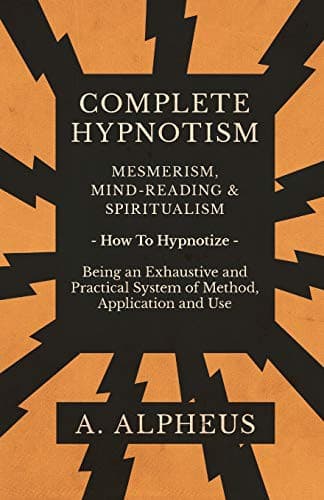
Complete Hypnotism, Mesmerism, Mind-Reading and Spiritualism: How to Hypnotize: Being an Exhaustive and Practical System of Method, Application, and UseAlpheus, A.
History
Complete Hypnotism, Mesmerism, Mind-Reading and Spiritualism: How to Hypnotize: Being an Exhaustive and Practical System of Method, Application, and Use
Alpheus, A.
Hypnotism; Mesmerism; Spiritualism; Telepathy
that the weak are sometimes helped for good; but there is no case on
record in which a person who really wished to be bad was ever made
good; and the history of hypnotism is full of attempts in that
direction. A good illustration is an experiment tried by Colonel de
Rochas:
“An excellent subject * * * had been left alone for a few minutes in an
apartment, and had stolen a valuable article. After he had left, the
theft was discovered. A few days after it was suggested to the subject,
while asleep, that he should restore the stolen object; the command was
energetically and imperatively reiterated, but in vain. The theft had
been committed by the subject, who had sold the article to an old
curiosity dealer, as it was eventually found on information received
from a third party. Yet this subject would execute all the imaginary
crimes he was ordered.”
As to the value of the so-called “laboratory crimes,” the statement of
Dr. Courmelles is of interest: “I have heard a subject say,” he states,
“‘If I were ordered to throw myself out of the window I should do it,
so certain am I either that there would be somebody under the window to
catch me or that I should be stopped in time. The experimentalist’s own
interests and the consequences of such an act are a sure guarantee.’”
CHAPTER VIII.
Dangers in Being Hypnotized.—Condemnation of Public Performances.—A.
Common Sense View.—Evidence Furnished by Lafontaine.—By Dr.
Courmelles.—By. Dr. Hart.—By Dr. Cocke.—No Danger in Hypnotism if
Rightly Used by Physicians or Scientists.
Having considered the dangers to society through criminal hypnotic
suggestion, let us now consider what dangers there may be to the
individual who is hypnotized.
Before citing evidence, let us consider the subject from a rational
point of view. Several things have already been established. We know
that hypnotism is akin to hysteria and other forms of insanity—it is,
in short, a kind of experimental insanity. Really good hypnotic
subjects have not a perfect mental balance. We have also seen that
repetition of the process increases the susceptibility, and in some
cases persons frequently hypnotized are thrown into the hypnotic state
by very slight physical agencies, such as looking at a bright doorknob.
Furthermore, we know that the hypnotic patient is in a very sensitive
condition, easily impressed. Moreover, it is well known that exertions
required of hypnotic subjects are nervously very exhausting, so much so
that headache frequently follows.
Public-domain text, read in full here on John Shaqi.
Reviews
Reviews
No reviews yet
Be the first to share your thoughts on this work.
Join the Discussion
Join the discussion
Sign in to leave a comment or review.
Sign InorCreate an account