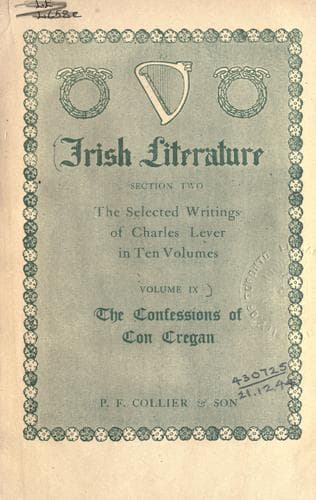
Confessions Of Con Cregan, the Irish Gil BlasLever, Charles
General
Confessions Of Con Cregan, the Irish Gil Blas
Lever, Charles
Ireland -- Fiction
At last, out came my captain, with a haste and flurry of manner quite
unusual. He did not, as was his constant custom, pass his hand along the
mare's neck to feel her coat, nor did he mutter a single word of coaxing
to her as he mounted. He flung himself with a jerk into the saddle, and,
rapping my knuckles sharply with the gold knob of his whip, pettishly
cried, "Let her go, sirrah!" and cantered away. I stood for some moments
motionless, my mind in that strange state when the first thought of
rebellion has entered, and the idea of reprisal has occurred. I was
about to go away, when the drawing-room window, straight above me, was
opened, and a lady stepped out upon the balcony. It was too dark to
discern either her features or her dress; but a certain instinct told me
it was Mrs. Mansergh. "Are you Captain De Courcy's boy?" said she, in a
sweet and subdued voice. I replied in the affirmative, and she went on:
"You know his quarters at the Royal Hospital? Well, go there at once,
as speedily as you can, and give him this note." She hesitated for a
second, as if uncertain what to say, and then added, "It is a note he
dropped from his pocket by accident."
"I'll do it, ma'am," said I, catching the letter and the half-crown,
which she had half inserted in the envelope to give it weight. "You
may trust me perfectly." Before the words were well uttered, she had
retired, the window was closed, the curtain drawn, and, except the
letter and the coin in my fingers, nothing remained to show that the
whole had not been a trick of my foolish brain.
My immediate impulse was to fulfil my mission; I even started off at
full speed to do so. But as I turned the corner of the Square, the glare
of a bright gas-lamp suggested the temptation of at least a look at
my despatches; and what was my astonishment to find that on this note,
which had been dropped by "accident" from the captain's pocket, the
superscription was scarcely dry,--in the very act of catching, I had
blotted the words! This, of course, was no affair of mine; but it
evinced deception,--and deception at certain moments becomes a dangerous
injury. There are times when the mind feels deceit to be an outrage. The
stormy passions of the fury-driven mob, reckless and headstrong, show
this; and the most terrible moment in all political convulsions is when
the people feel, or even suspect, that they have been tricked. My frame
of mind was exactly in that critical stage. A minute before, I was
ready to yield any obedience, tender any service; and now, of a
sudden,--without the slightest real cause, or from anything which could
in the remotest way affect me,--I had become a rebel. Let the reader
forgive the somewhat tedious analysis of a motive, since it comes from
one who has long studied the science of moral chemistry, and made most
of his experiments--as the rule directs--in "ignoble bodies."
Public-domain text, read in full here on John Shaqi.
Reviews
Reviews
No reviews yet
Be the first to share your thoughts on this work.
Join the Discussion
Join the discussion
Sign in to leave a comment or review.
Sign InorCreate an account