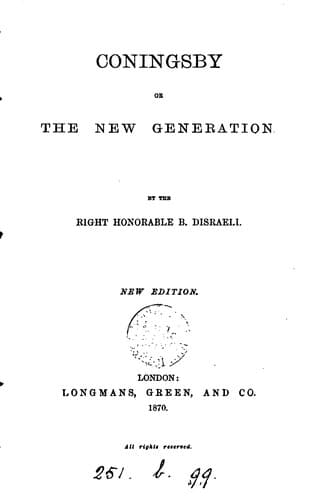
Coningsby; Or, The New GenerationDisraeli, Benjamin, Earl of Beaconsfield
General
Coningsby; Or, The New Generation
Disraeli, Benjamin, Earl of Beaconsfield
Great Britain -- Fiction; Political fiction; Politicians -- Fiction
The act of the Congress of Vienna remains the eternal monument of their
diplomatic knowledge and political sagacity. Their capital feats were
the creation of two kingdoms, both of which are already erased from
the map of Europe. They made no single preparation for the inevitable,
almost impending, conjunctures of the East. All that remains of
the pragmatic arrangements of the mighty Congress of Vienna is the
mediatisation of the petty German princes.
But the settlement of Europe by the pseudo-Tories was the dictate of
inspiration compared with their settlement of England. The peace of
Paris found the government of this country in the hands of a body of men
of whom it is no exaggeration to say that they were ignorant of every
principle of every branch of political science. So long as our domestic
administration was confined merely to the raising of a revenue, they
levied taxes with gross facility from the industry of a country too busy
to criticise or complain. But when the excitement and distraction of
war had ceased, and they were forced to survey the social elements
that surrounded them, they seemed, for the first time, to have become
conscious of their own incapacity. These men, indeed, were the mere
children of routine. They prided themselves on being practical men. In
the language of this defunct school of statesmen, a practical man is a
man who practises the blunders of his predecessors.
Now commenced that Condition-of-England Question of which our generation
hears so much. During five-and-twenty years every influence that can
develop the energies and resources of a nation had been acting with
concentrated stimulation on the British Isles. National peril and
national glory; the perpetual menace of invasion, the continual triumph
of conquest; the most extensive foreign commerce that was ever conducted
by a single nation; an illimitable currency; an internal trade supported
by swarming millions whom manufacturers and inclosure-bills summoned
into existence; above all, the supreme control obtained by man over
mechanic power, these are some of the causes of that rapid advance of
material civilisation in England, to which the annals of the world can
afford no parallel. But there was no proportionate advance in our moral
civilisation. In the hurry-skurry of money-making, men-making, and
machine-making, we had altogether outgrown, not the spirit, but the
organisation, of our institutions.
The peace came; the stimulating influences suddenly ceased; the people,
in a novel and painful position, found themselves without guides.
They went to the ministry; they asked to be guided; they asked to be
governed. Commerce requested a code; trade required a currency; the
unfranchised subject solicited his equal privilege; suffering labour
clamoured for its rights; a new race demanded education. What did the
ministry do?
Public-domain text, read in full here on John Shaqi.
Reviews
Reviews
No reviews yet
Be the first to share your thoughts on this work.
Join the Discussion
Join the discussion
Sign in to leave a comment or review.
Sign InorCreate an account