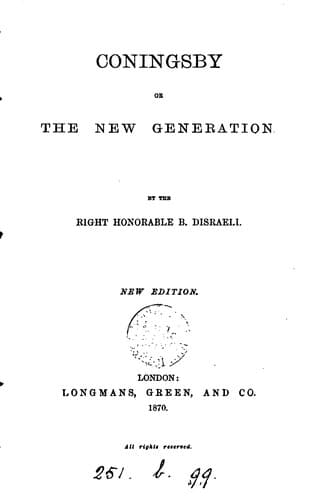
Coningsby; Or, The New GenerationDisraeli, Benjamin, Earl of Beaconsfield
General
Coningsby; Or, The New Generation
Disraeli, Benjamin, Earl of Beaconsfield
Great Britain -- Fiction; Political fiction; Politicians -- Fiction
Notwithstanding, however, all this successful mystification, the
Arch-Mediocrity who presided, rather than ruled, over this Cabinet
of Mediocrities, became hourly more conscious that the inevitable
transition from fulfilling the duties of an administration to performing
the functions of a government could not be conducted without talents and
knowledge. The Arch-Mediocrity had himself some glimmering traditions
of political science. He was sprung from a laborious stock, had received
some training, and though not a statesman, might be classed among
those whom the Lord Keeper Williams used to call ‘statemongers.’ In a
subordinate position his meagre diligence and his frigid method might
not have been without value; but the qualities that he possessed were
misplaced; nor can any character be conceived less invested with the
happy properties of a leader. In the conduct of public affairs his
disposition was exactly the reverse of that which is the characteristic
of great men. He was peremptory in little questions, and great ones he
left open.
In the natural course of events, in 1819 there ought to have been a
change of government, and another party in the state should have entered
into office; but the Whigs, though they counted in their ranks at that
period an unusual number of men of great ability, and formed, indeed, a
compact and spirited opposition, were unable to contend against the new
adjustment of borough influence which had occurred during the war,
and under the protracted administration by which that war had been
conducted. New families had arisen on the Tory side that almost rivalled
old Newcastle himself in their electioneering management; and it was
evident that, unless some reconstruction of the House of Commons could
be effected, the Whig party could never obtain a permanent hold of
official power. Hence, from that period, the Whigs became Parliamentary
Reformers.
It was inevitable, therefore, that the country should be governed by the
same party; indispensable that the ministry should be renovated by new
brains and blood. Accordingly, a Mediocrity, not without repugnance, was
induced to withdraw, and the great name of Wellington supplied his place
in council. The talents of the Duke, as they were then understood, were
not exactly of the kind most required by the cabinet, and his colleagues
were careful that he should not occupy too prominent a post; but
still it was an impressive acquisition, and imparted to the ministry a
semblance of renown.
Public-domain text, read in full here on John Shaqi.
Reviews
Reviews
No reviews yet
Be the first to share your thoughts on this work.
Join the Discussion
Join the discussion
Sign in to leave a comment or review.
Sign InorCreate an account