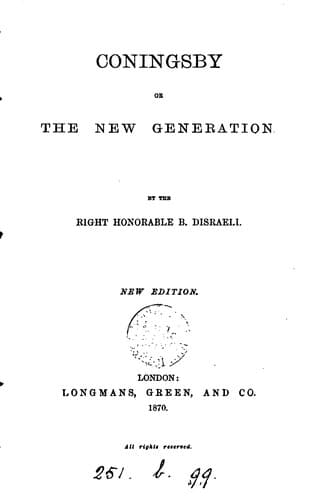
Coningsby; Or, The New GenerationDisraeli, Benjamin, Earl of Beaconsfield
General
Coningsby; Or, The New Generation
Disraeli, Benjamin, Earl of Beaconsfield
Great Britain -- Fiction; Political fiction; Politicians -- Fiction
This ministry, strong in the confidence of the sovereign, the
parliament, and the people, might, by the courageous promulgation of
great historical truths, have gradually formed a public opinion, that
would have permitted them to organise the Tory party on a broad, a
permanent, and national basis. They might have nobly effected a complete
settlement of Ireland, which a shattered section of this very cabinet
was forced a few years after to do partially, and in an equivocating
and equivocal manner. They might have concluded a satisfactory
reconstruction of the third estate, without producing that convulsion
with which, from its violent fabrication, our social system still
vibrates. Lastly, they might have adjusted the rights and properties
of our national industries in a manner which would have prevented that
fierce and fatal rivalry that is now disturbing every hearth of the
United Kingdom.
We may, therefore, visit on the _laches_ of this ministry the
introduction of that new principle and power into our constitution which
ultimately may absorb all, AGITATION. This cabinet, then, with so much
brilliancy on its surface, is the real parent of the Roman Catholic
Association, the Political Unions, the Anti-Corn-Law League.
There is no influence at the same time so powerful and so singular as
that of individual character. It arises as often from the weakness of
the character as from its strength. The dispersion of this clever and
showy ministry is a fine illustration of this truth. One morning the
Arch-Mediocrity himself died. At the first blush, it would seem that
little difficulties could be experienced in finding his substitute. His
long occupation of the post proved, at any rate, that the qualification
was not excessive. But this cabinet, with its serene and blooming
visage, had been all this time charged with fierce and emulous
ambitions. They waited the signal, but they waited in grim repose.
The death of the nominal leader, whose formal superiority, wounding no
vanity, and offending no pride, secured in their councils equality among
the able, was the tocsin of their anarchy. There existed in this cabinet
two men, who were resolved immediately to be prime ministers; a third
who was resolved eventually to be prime minister, but would at any rate
occupy no ministerial post without the lead of a House of Parliament;
and a fourth, who felt himself capable of being prime minister, but
despaired of the revolution which could alone make him one; and who
found an untimely end when that revolution had arrived.
Public-domain text, read in full here on John Shaqi.
Reviews
Reviews
No reviews yet
Be the first to share your thoughts on this work.
Elsewhere in the archive
Join the Discussion
Join the discussion
Sign in to leave a comment or review.
Sign InorCreate an account