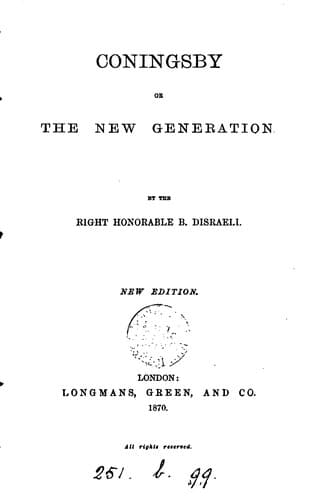
Coningsby; Or, The New GenerationDisraeli, Benjamin, Earl of Beaconsfield
General
Coningsby; Or, The New Generation
Disraeli, Benjamin, Earl of Beaconsfield
Great Britain -- Fiction; Political fiction; Politicians -- Fiction
This would seem something of a predicament! To common minds; there are
no such things as scrapes for gentlemen with Mr. Rigby’s talents for
action. He had indeed, in the world, the credit of being an adept in
machinations, and was supposed ever to be involved in profound and
complicated contrivances. This was quite a mistake. There was nothing
profound about Mr. Rigby; and his intellect was totally incapable of
devising or sustaining an intricate or continuous scheme. He was, in
short, a man who neither felt nor thought; but who possessed, in a
very remarkable degree, a restless instinct for adroit baseness. On the
present occasion he got into his carriage, and drove at the utmost speed
from Windsor to the Foreign Office. The Secretary of State was engaged
when he arrived; but Mr. Rigby would listen to no difficulties. He
rushed upstairs, flung open the door, and with agitated countenance, and
eyes suffused with tears, threw himself into the arms of the astonished
Mr. Canning.
‘All is right,’ exclaimed the devoted Rigby, in broken tones; ‘I have
convinced the King that the First Minister must be in the House of
Commons. No one knows it but myself; but it is certain.’
We have seen that at an early period of his career, Mr. Peel withdrew
from official life. His course had been one of unbroken prosperity; the
hero of the University had become the favourite of the House of Commons.
His retreat, therefore, was not prompted by chagrin. Nor need it have
been suggested by a calculating ambition, for the ordinary course of
events was fast bearing to him all to which man could aspire. One
might rather suppose, that he had already gained sufficient experience,
perhaps in his Irish Secretaryship, to make him pause in that career of
superficial success which education and custom had hitherto chalked out
for him, rather than the creative energies of his own mind. A thoughtful
intellect may have already detected elements in our social system which
required a finer observation, and a more unbroken study, than the gyves
and trammels of office would permit. He may have discovered that the
representation of the University, looked upon in those days as the
blue ribbon of the House of Commons, was a sufficient fetter without
unnecessarily adding to its restraint. He may have wished to reserve
himself for a happier occasion, and a more progressive period. He may
have felt the strong necessity of arresting himself in his rapid career
of felicitous routine, to survey his position in calmness, and to
comprehend the stirring age that was approaching.
Public-domain text, read in full here on John Shaqi.
Reviews
Reviews
No reviews yet
Be the first to share your thoughts on this work.
Elsewhere in the archive
Join the Discussion
Join the discussion
Sign in to leave a comment or review.
Sign InorCreate an account