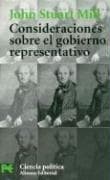
Considerations on Representative GovernmentMill, John Stuart
PhilosophyPhilosophy
Considerations on Representative Government
Mill, John Stuart
Representative government and representation
But it is equally true, though only of late and slowly beginning to be
acknowledged, that a numerous assembly is as little fitted for the
direct business of legislation as for that of administration. There is
hardly any kind of intellectual work which so much needs to be done
not only by experienced and exercised minds, but by minds trained to
the task through long and laborious study, as the business of making
laws. This is a sufficient reason, were there no other, why they can
never be well made but by a committee of very few persons. A reason no
less conclusive is, that every provision of a law requires to be
framed with the most accurate and long-sighted perception of its
effect on all the other provisions; and the law when made should be
capable of fitting into a consistent whole with the previously
existing laws. It is impossible that these conditions should be in any
degree fulfilled when laws are voted clause by clause in a
miscellaneous assembly. The incongruity of such a mode of legislating
would strike all minds, were it not that our laws are already, as to
form and construction, such a chaos, that the confusion and
contradiction seem incapable of being made greater by any addition to
the mass. Yet even now, the utter unfitness of our legislative
machinery for its purpose is making itself practically felt every year
more and more. The mere time necessarily occupied in getting through
bills, renders Parliament more and more incapable of passing any,
except on detached and narrow points. If a bill is prepared which even
attempts to deal with the whole of any subject (and it is impossible
to legislate properly on any part without having the whole present to
the mind), it hangs over from session to session through sheer
impossibility of finding time to dispose of it. It matters not though
the bill may have been deliberately drawn up by the authority deemed
the best qualified, with all appliances and means to boot; or by a
select commission, chosen for their conversancy with the subject, and
having employed years in considering and digesting the particular
measure: it can not be passed, because the House of Commons will not
forego the precious privilege of tinkering it with their clumsy hands.
The custom has of late been to some extent introduced, when the
principle of a bill has been affirmed on the second reading, of
referring it for consideration in detail to a select committee; but it
has not been found that this practice causes much less time to be lost
afterwards in carrying it through the committee of the whole House:
the opinions or private crotchets which have been overruled by
knowledge always insist on giving themselves a second chance before
the tribunal of ignorance. Indeed, the practice itself has been
adopted principally by the House of Lords, the members of which are
less busy and fond of meddling, and less jealous of the importance of
their individual voices, than those of the elective House. And when a
Public-domain text, read in full here on John Shaqi.
Reviews
Reviews
No reviews yet
Be the first to share your thoughts on this work.
Elsewhere in the archive
Join the Discussion
Join the discussion
Sign in to leave a comment or review.
Sign InorCreate an account