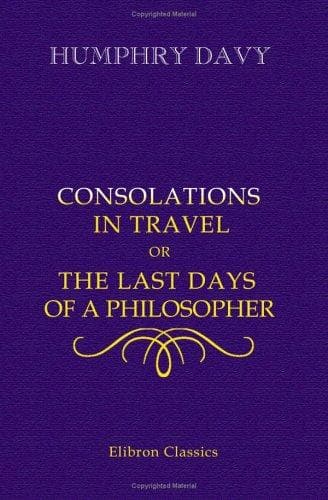
Consolations in Travel; or, the Last Days of a PhilosopherDavy, Humphry, Sir
Philosophy
Consolations in Travel; or, the Last Days of a Philosopher
Davy, Humphry, Sir
Chemists -- Great Britain -- Biography; Davy, Humphry, Sir, 1778-1829
_Onu_.--Having resided for a long time in Edinburgh, and having heard a
number of discussions on the theory of Dr. Hutton, or the plutonic theory
of geology, and having been exceedingly struck both by its simplicity and
beauty, its harmony with existing facts, and the proofs afforded to it by
some beautiful chemical experiments, I do not feel disposed immediately
to renounce it for the views which I have just heard explained; for the
principal facts which our new acquaintance has stated are, I think, not
inconsistent with the refined philosophical systems of Professor Playfair
and Sir James Hall.
_The Unknown_.--I have no objection to the refined plutonic view, as
capable of explaining many existing phenomena; indeed, you must be aware
that I have myself had recourse to it. What I contend against is, its
application to explain the formations of the secondary rocks, which I
think clearly belong to an order of facts not at all embraced by it. In
the plutonic system there is one simple and constant order assumed, which
may be supposed eternal. The surface is constantly imagined to be
disintegrated, destroyed, degraded, and washed into the bosom of the
ocean by water, and as constantly consolidated, elevated, and regenerated
by fire, and the ruins of the old form the foundations of the new world.
It is supposed that there are always the same types, both of dead and
living matter; that the remains of rocks, of vegetables, and animals of
one age are found embedded in rocks raised from the bottom of the ocean
in another. Now, to support this view, not only the remains of living
beings which at present people the globe might be expected to be found in
the oldest secondary strata, but even those of the arts of man, the most
powerful and populous of its inhabitants, which is well known not to be
the case. On the contrary, each stratum of the secondary rocks contains
remains of peculiar and mostly now unknown species of vegetables and
animals. In those strata which are deepest, and which must consequently
be supposed to be the earliest deposited, forms even of vegetable life
are rare; shells and vegetable remains are found in the next order; the
bones of fishes and oviparous reptiles exist in the following class; the
remains of birds, with those of the same genera mentioned before, in the
next order; those of quadrupeds of extinct species, in a still more
recent class; and it is only in the loose and slightly consolidated
strata of gravel and sand, and which are usually called diluvian
formations, that the remains of animals such as now people the globe are
found, with others belonging to extinct species. But in none of these
formations, whether called secondary, tertiary, or diluvial, have the
remains of man or any of his works been discovered. It is, I think,
impossible to consider the organic remains found in any of the earlier
secondary strata, the lias-limestone and its congenerous formations for
Public-domain text, read in full here on John Shaqi.
Reviews
Reviews
No reviews yet
Be the first to share your thoughts on this work.
Elsewhere in the archive
Join the Discussion
Join the discussion
Sign in to leave a comment or review.
Sign InorCreate an account