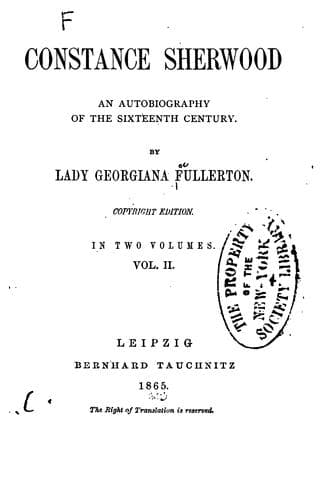
Constance Sherwood: An Autobiography of the Sixteenth CenturyFullerton, Georgiana
History
Constance Sherwood: An Autobiography of the Sixteenth Century
Fullerton, Georgiana
Great Britain -- History -- Elizabeth, 1558-1603 -- Fiction
The first night of our journey we lay at a small inn, which was held
by persons Mistress Ward was acquainted with, and by whom we were
entertained in a decent chamber, looking on unto a little garden, and
with as much comfort as the fashion of the place might afford, and
greater cleanliness than is often to be found in larger hostelries.
After supper, being somewhat weary with travel, but not yet inclined
for bed, and the evening fine, we sat out of doors in a bower of
eglantine near to some bee-hives, of which our hostess had a great
store; and methinks she took example from them, for we could see her
through the window as busy in the kitchen amongst her maids as the
queen-bee amidst her subjects. Mistress Ward took occasion to observe,
as we watched one of these little commonwealths of nature, that she
admired how they do live, laboring and swarming, and gathering honey
together so neat and finely, that they abhor nothing so much as
uncleanliness, drinking pure and clear water, even the dew-drops on
the leaves and flowers, and delighting in sweet music, which if
they hear but once out of tune they fly out of sight.
"They live," she said, "under a law, and use great reverence to their
elders. Every one hath his office; some trimming the honey, another
framing hives, another the combs. When they go forth to work, they
mark the wind and the clouds, and whatsoever doth threaten their ruin;
and having gathered, out of every flower, honey, they return loaded in
their mouths and on their wings, whom they that tarried at home
receive readily, easing their backs of their great burthens with as
great care as can be thought of."
"Methinks," I answered, "that if it be as you say, Mistress Ward, the
bees be wiser than men."
At the which she smiled; but withal, sighing, made reply:
"One might have wished of late years rather to be a bee than such as
we see men sometimes to be. But, Mistress Constance, if they are
indeed so wise and so happy, 'tis that they are fixed in a condition
in which they must needs do the will of him who created them; and the
like wisdom and happiness in a far higher state we may ourselves
enjoy, if we do but choose of our free will to live by the same rule."
Then, after some further discourse on the habits of these little
citizens, I inquired of Mistress Ward if she were acquainted with mine
aunt, Mistress Congleton; at the which question she seemed surprised,
and said,
"Methought, my dear, you had known my condition in your aunt's family,
having been governess for many years to her three daughters, and only
by reason of my sister's sickness having stayed away from them for
some time."
Public-domain text, read in full here on John Shaqi.
Reviews
Reviews
No reviews yet
Be the first to share your thoughts on this work.
Join the Discussion
Join the discussion
Sign in to leave a comment or review.
Sign InorCreate an account