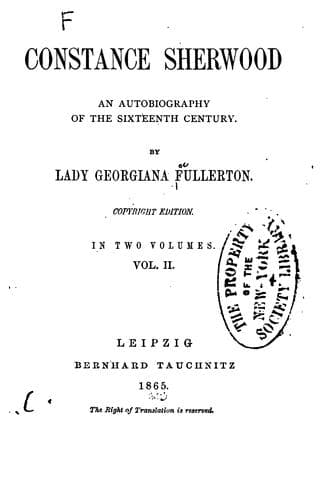
Constance Sherwood: An Autobiography of the Sixteenth CenturyFullerton, Georgiana
History
Constance Sherwood: An Autobiography of the Sixteenth Century
Fullerton, Georgiana
Great Britain -- History -- Elizabeth, 1558-1603 -- Fiction
"Then if it please you, sir, when the time comes," I said, "I would
like to look on and not to ride;" and he replied, it should be as I
pleased; and with such merry discourse we spent the time till supper
was ready. And afterward that good gentleman slackened not his efforts
in entertaining us; but related so many laughable stories, and took so
great notice of me, that I was moved to answer him sometimes in a
manner too forward for my years. He told us of the queen's visit to
that city, and that the mayor, who had heard her grace's majesty
considered poets, and herself wrote verses, thought to commend himself
to her favor by such rare rhymes as these, wherewith he did greet her
at her entrance into the town:
"We, the men of Coventry,
Be pleased to see your majesty,
Good Lord! how fair you be!"
at the which her highness made but an instant's pause, and then
straightway replied,
"It pleaseth well her majesty
To see the men of Coventry.
Good Lord! what fools you be!"
"But," quoth Mr. Page, "the good man was so well pleased that the
Queen had answered his compliment, that 'tis said he has had her
majesty's speech framed, and hung up in his parlor."
"Pity 'tis not in the town-hall," I cried; and he laughing commended
me for sharpness; but Mistress Ward said:
"A sharp tongue in a woman's head was always a stinging weapon; but in
a queen's she prayed God it might never prove a murtherous one." Which
words somewhat checked our merriment, for that they savored of rebuke
to me for forward speech, and I ween awoke in Mr. Page thoughts of a
graver sort.
When we rode through the town next day, he went with us for the space
of some miles, and then bade us farewell with singular courtesy, and
professions of good will and proffered service if we should do him the
good at any time to remember his poor house; which we told him he had
given us sufficient reason not to forget. Toward evening, when the sun
was setting, we did see the towers of Warwick Castle; and I would fain
have discerned the one which doth bear the name of the great earl who
in a poor pilgrim's garb slew the giant Colbrand, and the cave 'neath
Guy's Cliff where he spent his last years in prayer. But the light was
declining as we rode into Leamington, where we lay that night, and
darkness hid from us that fair country, which methought was a meet
abode for such as would lead a hermit's life.
Public-domain text, read in full here on John Shaqi.
Reviews
Reviews
No reviews yet
Be the first to share your thoughts on this work.
Join the Discussion
Join the discussion
Sign in to leave a comment or review.
Sign InorCreate an account