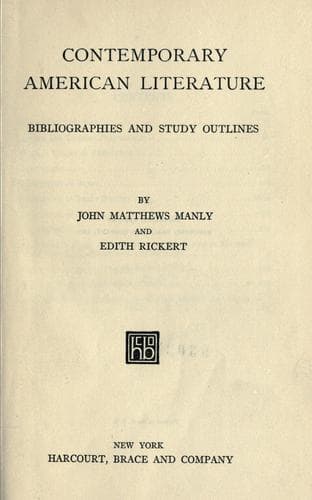
Contemporary American Literature: Bibliographies and Study OutlinesManly, John Matthews
General
Contemporary American Literature: Bibliographies and Study Outlines
Manly, John Matthews
American literature -- 20th century -- Bio-bibliography; American literature -- Outlines, syllabi, etc.
Bookm. 11 ('00): 501 (portrait); 21 ('05): 79 (portrait), 564, 565
(portrait); 29 ('09): 236 (portrait); 31 ('14): 241 (portrait);
37 ('13): 598 (portrait); 41 ('15): 246 (portrait); 53 ('21): 124.
Cent. 102 ('21): 191.
Critic, 36 ('00): 487 (portrait).
Cur. Lit. 39 ('05): 75 (portrait); 42 ('07): 167; 47 ('09): 57
(portrait).
Cur. Op. 65 ('18): 392; 70 ('21): 534. (Portraits.)
Forum, 41 ('09): 600.
Lit. Digest, 68 ('21): Mar. 5, p. 28 (portrait).
Liv. Age, 309 ('21): 426.
New Repub. 25 ('21): 357.
No. Am. 213 ('21): 556.
Outlook, 126 ('20): 469 (portrait); 127 ('21): 286.
Sat. Rev. 97 ('04): 551.
Spec. 115 ('15): 879.
+Fannie Hurst+ (Missouri, 1889)--short-story writer, novelist.
Has studied especially the lives of working girls. For bibliography, see
_Who's Who in America_.
+Wallace Irwin+ (New York, 1875)--short-story writer.
Most characteristic material life in California and the Japanese there.
For bibliography, see _Who's Who in America_.
+Henry James+--novelist.
Born in New York City, 1843. Younger brother of William James, the
psychologist. Educated largely in France and Switzerland. Studied at the
Harvard Law School. After 1869, lived for the most part abroad, chiefly
in England. Spent much time at Lamb House, Rye, a beautiful eighteenth
century English house which he purchased in order to live in retirement.
Just before his death, to show his sympathy for the part played by
England in the War and his criticism of what he considered our
backwardness, he became naturalized as a British citizen. In 1916,
received the Order of Merit (O.M.), the highest honor for literary men
conferred in England. His death in 1916 was attributed to overstrain
caused by the War and his efforts to help the sufferers.
SUGGESTIONS FOR READING
1. A good approach to the work of Henry James is through the three
articles from the _Quarterly Review_ listed below. Mr. Fullerton sums up
the material scattered through the prefaces to the definitive edition of
1909. Mr. Percy Lubbock writes as the editor of the _Letters_. Mrs.
Wharton adds to criticism of the _Letters_ illuminating personal
reminiscences.
2. One of the important _Prefaces_ on James's theory of the novel and his
method of work is that to the _Portrait of a Lady_, from which the
extract below is taken. In speaking of Turgenev's attitude toward his
characters, James says:
He saw them, in that fashion, as disponible, saw them subject to the
chances, the complications of existence, and saw them vividly but
then had to find for them the right relations, those that would most
bring them out; to imagine, to invent and select and piece together
the situations most useful and favourable to the sense of the
creatures themselves, the complications they would be most likely to
produce and to feel.
Public-domain text, read in full here on John Shaqi.
Reviews
Reviews
No reviews yet
Be the first to share your thoughts on this work.
Join the Discussion
Join the discussion
Sign in to leave a comment or review.
Sign InorCreate an account