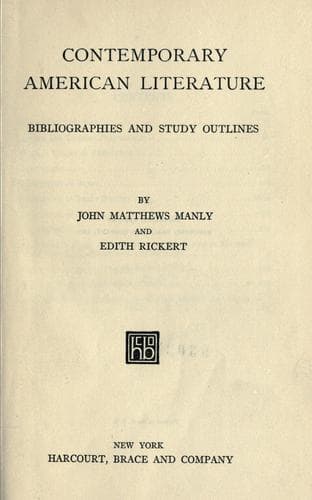
Contemporary American Literature: Bibliographies and Study OutlinesManly, John Matthews
General
Contemporary American Literature: Bibliographies and Study Outlines
Manly, John Matthews
American literature -- 20th century -- Bio-bibliography; American literature -- Outlines, syllabi, etc.
Literary Lapses. 1910.
Nonsense Novels. 1911.
Sunshine Sketches of a Little Town. 1912.
Behind the Beyond. 1913.
Arcadian Adventures with the Idle Rich. 1914.
Moonbeams from the Larger Lunacy. 1915.
Essays and Literary Studies. 1916.
Further Foolishness. 1916.
Frenzied Fiction. 1917.
The Hohenzollerns in America. 1919.
The Unsolved Riddle of Social Justice. 1920. (Sociological discussion.)
Winsome Winnie and Other New Nonsense Novels. 1920.
For study, see Bookm. (Lond.) 51 ('16): 39; also _Book Review Digest_,
1914-7, 1919, 1920.
+Jennette (Barbour Perry) Lee (Mrs. Gerald Stanley Lee)+--novelist.
Born at Bristol, Connecticut, 1860. A.B., Smith, 1886. Taught English at
Vassar, 1890-3; at Western Reserve, 1893-6; instructor and professor of
English at Smith, 1901-13.
BIBLIOGRAPHY
The Son of a Fiddler. 1902.
*Uncle William. 1906.
Happy Island. 1910.
Mr. Achilles. 1912.
The Taste of Apples. 1913.
Aunt Jane. 1915.
The Green Jacket. 1917.
The Air-Man and the Tramp. 1918.
The Rain-Coat Girl. 1919.
The Chinese Coat. 1920.
The Other Susan. 1921.
Uncle Bijah's Ghost. 1922.
STUDIES AND REVIEWS
Bk. Buyer, 22 ('01): 99 (portrait).
Bookm. 36 ('12): 347 (portrait); 38 ('13): 233, 236 (portrait).
See also _Book Review Digest_, 1913, 1915-8.
+Edwin Lefevre+ (Colombia, South America, 1871)--novelist, short-story
writer.
Uses Wall Street as material. For bibliography, see _Who's Who in
America_.
+Sinclair Lewis+--novelist.
Born at Sauk Center, Minnesota, 1885. Son of a physician. A.B., Yale,
1907. During the next ten years was a newspaper man in Connecticut, Iowa,
and California, a magazine editor in Washington, D.C., and editor for New
York book publishers. During the last five years has been traveling in
the United States, living from one day to six months in the most diverse
places, and motoring from end to end of twenty-six states. While
supporting himself by short stories and experimental novels, he laid the
foundation for his unusually successful _Main Street_. His first book,
_Our Mr. Wrenn_, is said to contain a good deal of autobiography.
SUGGESTIONS FOR READING
1. Do you recognize Gopher Prairie as a type? Is Mr. Lewis's picture
photography, caricature, or the kind of portraiture that is art? Or to
what degree do you find all these elements?
2. Is the main interest of the book in the story? in the
characterization? in the satire? or in an element of propaganda?
3. What is to be said of the constructive theory of living proposed by
the heroine? Is it better or worse than the standard that prevailed
before she went to Gopher Prairie to live?
4. Explain the success of the book. What, if any, elements of permanent
value do you find? What conspicuous defects?
BIBLIOGRAPHY
Our Mr. Wrenn. 1914.
The Trail of the Hawk. 1915.
The Job. 1917.
The Innocents. 1917.
Free Air. 1919.
*Main Street. 1920.
Babbitt. 1922.
Public-domain text, read in full here on John Shaqi.
Reviews
Reviews
No reviews yet
Be the first to share your thoughts on this work.
Elsewhere in the archive
Join the Discussion
Join the discussion
Sign in to leave a comment or review.
Sign InorCreate an account