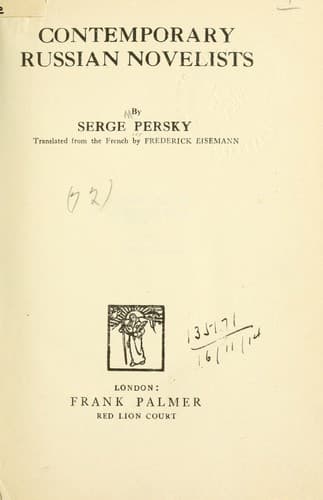
Novelists, Russian; Russian fiction -- History and criticism
In the work of Veressayev this student is Natasha. Reflection has
ripened her mind since her last talk with poor Chekanhov. She has
become a regular "mannish woman," having seen and thought a great
deal. She has traveled; she has lived in St. Petersburg and in the
south of Russia. Full of courage and energy, she claims to be fully
satisfied with her lot; she begs her companions to follow the road
she has found, and when they refuse she becomes angry with them. In
company with her comrade Dayev she vigorously attacks the
convictions of the men of Kisselev, who see sufficient safety in the
workingmen's associations; she rises up, in the name of Marxism,
against the "narodnikis," whom she considers ingenuous idealists;
she refuses to endorse the theories of the "intellectuals," who
oppose the thought of any great work, since they believe that
smaller deeds are more immediately realizable. When one of them, a
doctor, Troitsky, ends his conversation with her with these words:
"It is not necessary to wear one's brains out trying to solve
difficult problems while there is so much immediate need and so few
workers," she puts an end to the discussion. Shrugging her
shoulders, in a trembling voice she answers: "How can you live and
think as you do? New problems confront us, and you stand before them
and do nothing, because you have lost confidence. I can't work any
longer with you, because it would mean dedicating myself blindly to
'spiritual death.'"
Veressayev does not show us how she solves the problems of which she
speaks. The adepts of this sort of social apostleship usually
propagate their ideas among the workingmen, help them, and play a
part in conspiracies. Natasha offers herself up. But the censorship
has not allowed Veressayev to carry his subject on, and he has
limited himself to showing us Natasha in company with her friends
and disciples, giving herself up to oratorical tilts, discussing
principles, and uttering long discourses full of passion, faith, and
juvenile impatience,--discourses which unfortunately are mistaken in
their reasoning.
* * * * *
Public-domain text, read in full here on John Shaqi.
Reviews
Reviews
No reviews yet
Be the first to share your thoughts on this work.
Elsewhere in the archive
Join the Discussion
Join the discussion
Sign in to leave a comment or review.
Sign InorCreate an account