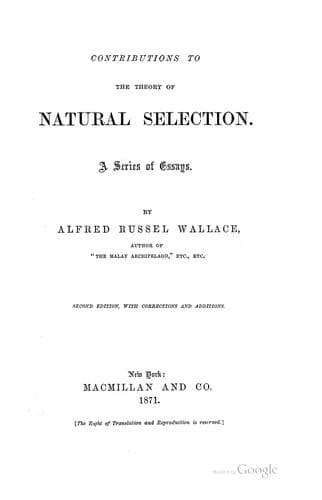
Contributions to the Theory of Natural Selection: A Series of EssaysWallace, Alfred Russel
Science
Contributions to the Theory of Natural Selection: A Series of Essays
Wallace, Alfred Russel
Natural selection
We have here an illustration of the simple and effectual means by which
animals are brought into harmony with the rest of nature. That slight
amount of variability in every species, which we often look upon as
something accidental or abnormal, or so insignificant as to be hardly
worthy of notice, is yet the foundation of all those wonderful and
harmonious resemblances which play such an important part in the economy
of nature. Variation is generally very small in amount, but it is all
that is required, because the change in the external conditions to which
an animal is subject is generally very slow and intermittent. When these
changes have taken place too rapidly, the result has often been the
extinction of species; but the general rule is, that climatal and
geological changes go on slowly, and the slight but continual
variations in the colour, form, and structure of all animals, has
furnished individuals adapted to these changes, and who have become the
progenitors of modified races. Rapid multiplication, incessant slight
variation, and survival of the fittest--these are the laws which ever
keep the organic world in harmony with the inorganic, and with itself.
These are the laws which we believe have produced all the cases of
protective resemblance already adduced, as well as those still more
curious examples we have yet to bring before our readers.
It must always be borne in mind that the more wonderful examples, in
which there is not only a general but a special resemblance--as in the
walking leaf, the mossy phasma, and the leaf-winged butterfly--represent
those few instances in which the process of modification has been going
on during an immense series of generations. They all occur in the
tropics, where the conditions of existence are the most favourable, and
where climatic changes have for long periods been hardly perceptible. In
most of them favourable variations both of colour, form, structure, and
instinct or habit, must have occurred to produce the perfect adaptation
we now behold. All these are known to vary, and favourable variations
when not accompanied by others that were unfavourable, would certainly
survive. At one time a little step might be made in this direction, at
another time in that--a change of conditions might sometimes render
useless that which it had taken ages to produce--great and sudden
physical modifications might often produce the extinction of a race
just as it was approaching perfection, and a hundred checks of which we
can know nothing may have retarded the progress towards perfect
adaptation; so that we can hardly wonder at there being so few cases in
which a completely successful result has been attained as shown by the
abundance and wide diffusion of the creatures so protected.
_Objection that Colour, as being dangerous, should not exist in Nature._
Public-domain text, read in full here on John Shaqi.
Reviews
Reviews
No reviews yet
Be the first to share your thoughts on this work.
Join the Discussion
Join the discussion
Sign in to leave a comment or review.
Sign InorCreate an account