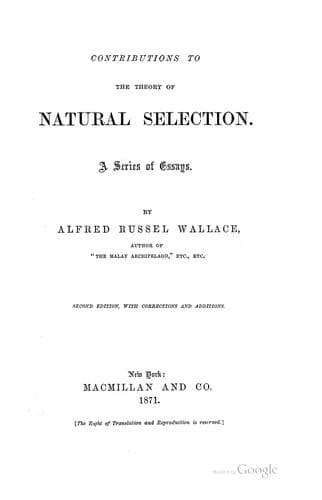
Contributions to the Theory of Natural Selection: A Series of EssaysWallace, Alfred Russel
Science
Contributions to the Theory of Natural Selection: A Series of Essays
Wallace, Alfred Russel
Natural selection
The great family of ground beetles (Carabidae) almost all possess a
disagreeable and some a very pungent smell, and a few, called bombardier
beetles, have the peculiar faculty of emitting a jet of very volatile
liquid, which appears like a puff of smoke, and is accompanied by a
distinct crepitating explosion. It is probably because these insects are
mostly nocturnal and predacious that they do not present more vivid
hues. They are chiefly remarkable for brilliant metallic tints or dull
red patches when they are not wholly black, and are therefore very
conspicuous by day, when insect-eaters are kept off by their bad odour
and taste, but are sufficiently invisible at night when it is of
importance that their prey should not become aware of their proximity.
It seems probable that in some cases that which would appear at first to
be a source of danger to its possessor may really be a means of
protection. Many showy and weak-flying butterflies have a very broad
expanse of wing, as in the brilliant blue Morphos of Brazilian forests,
and the large Eastern Papilios; yet these groups are tolerably
plentiful. Now, specimens of these butterflies are often captured with
pierced and broken wings, as if they had been seized by birds from whom
they had escaped; but if the wings had been much smaller in proportion
to the body, it seems probable that the insect would be more frequently
struck or pierced in a vital part, and thus the increased expanse of the
wings may have been indirectly beneficial.
In other cases the capacity of increase in a species is so great that
however many of the perfect insect may be destroyed, there is always
ample means for the continuance of the race. Many of the flesh flies,
gnats, ants, palm-tree weevils and locusts are in this category. The
whole family of Cetoniadae or rose chafers, so full of gaily-coloured
species, are probably saved from attack by a combination of characters.
They fly very rapidly with a zigzag or waving course; they hide
themselves the moment they alight, either in the corolla of flowers, or
in rotten wood, or in cracks and hollows of trees, and they are
generally encased in a very hard and polished coat of mail which may
render them unsatisfactory food to such birds as would be able to
capture them. The causes which lead to the development of colour have
been here able to act unchecked, and we see the result in a large
variety of the most gorgeously-coloured insects.
Public-domain text, read in full here on John Shaqi.
Reviews
Reviews
No reviews yet
Be the first to share your thoughts on this work.
Join the Discussion
Join the discussion
Sign in to leave a comment or review.
Sign InorCreate an account