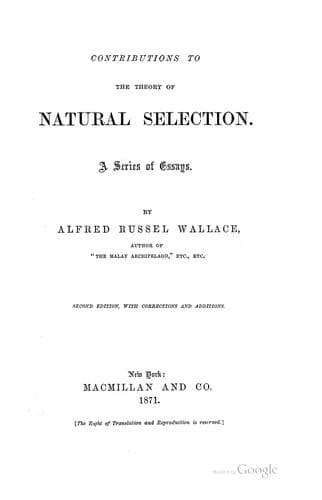
Contributions to the Theory of Natural Selection: A Series of EssaysWallace, Alfred Russel
Science
Contributions to the Theory of Natural Selection: A Series of Essays
Wallace, Alfred Russel
Natural selection
Now let us consider how this kind of protection must act. Tropical
insectivorous birds very frequently sit on dead branches of a lofty
tree, or on those which overhang forest paths, gazing intently around,
and darting off at intervals to seize an insect at a considerable
distance, which they generally return to their station to devour. If a
bird began by capturing the slow-flying, conspicuous Heliconidae, and
found them always so disagreeable that it could not eat them, it would
after a very few trials leave off catching them at all; and their whole
appearance, form, colouring, and mode of flight is so peculiar, that
there can be little doubt birds would soon learn to distinguish them at
a long distance, and never waste any time in pursuit of them. Under
these circumstances, it is evident that any other butterfly of a group
which birds were accustomed to devour, would be almost equally well
protected by closely resembling a Heliconia externally, as if it
acquired also the disagreeable odour; always supposing that there were
only a few of them among a great number of the Heliconias. If the birds
could not distinguish the two kinds externally, and there were on the
average only one eatable among fifty uneatable, they would soon give up
seeking for the eatable ones, even if they knew them to exist. If, on
the other hand, any particular butterfly of an eatable group acquired
the disagreeable taste of the Heliconias while it retained the
characteristic form and colouring of its own group, this would be really
of no use to it whatever; for the birds would go on catching it among
its eatable allies (compared with which it would rarely occur), it would
be wounded and disabled, even if rejected, and its increase would thus
be as effectually checked as if it were devoured. It is important,
therefore, to understand that if any one genus of an extensive family of
eatable butterflies were in danger of extermination from insect-eating
birds, and if two kinds of variation were going on among them, some
individuals possessing a slightly disagreeable taste, others a slight
resemblance to the Heliconidae, this latter quality would be much more
valuable than the former. The change in flavour would not at all prevent
the variety from being captured as before, and it would almost certainly
be thoroughly disabled before being rejected. The approach in colour and
form to the Heliconidae, however, would be at the very first a positive,
though perhaps a slight advantage; for although at short distances this
variety would be easily distinguished and devoured, yet at a longer
distance it might be mistaken for one of the uneatable group, and so be
passed by and gain another day's life, which might in many cases be
sufficient for it to lay a quantity of eggs and leave a numerous
progeny, many of which would inherit the peculiarity which had been the
safeguard of their parent.
Public-domain text, read in full here on John Shaqi.
Reviews
Reviews
No reviews yet
Be the first to share your thoughts on this work.
Elsewhere in the archive
Join the Discussion
Join the discussion
Sign in to leave a comment or review.
Sign InorCreate an account