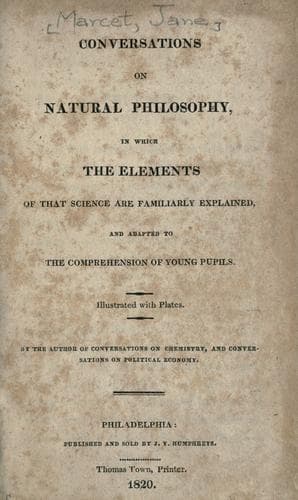
Conversations on Natural Philosophy, in which the Elements of that Science are Familiarly ExplainedMarcet, Mrs. (Jane Haldimand)
Science
Conversations on Natural Philosophy, in which the Elements of that Science are Familiarly Explained
Marcet, Mrs. (Jane Haldimand)
Physics
_Mrs. B._ Prolong the lines in the directions of the two forces, and you
will soon discover which way the ball will be impelled; it will move
from A to D, in the diagonal of a parallelogram, (fig. 7.) Forces acting
in the direction of lines forming an obtuse angle, will also produce
motion in the diagonal of a parallelogram. For instance, if the body set
out from B, instead of A, and was impelled by the forces X and Y, it
would move in the dotted diagonal B C.
We may now proceed to curvilinear motion: this is the result of two
forces acting on a body; by one of which, it is projected forward in a
right line; whilst by the other, it is drawn or impelled towards a fixed
point. For instance, when I whirl this ball, which is fastened to my
hand with a string, the ball moves in a circular direction, because it
is acted on by two forces; that which I give it, which represents the
force of projection, and that of the string which confines it to my
hand. If, during its motion you were suddenly to cut the string, the
ball would fly off in a straight line; being released from that
confinement which caused it to move round a fixed point, it would be
acted on by one force only; and motion produced by one force, you know,
is always in a right line.
_Caroline._ This circular motion, is a little more difficult to
comprehend than compound motion in straight lines.
_Mrs. B._ You have seen how the water is thrown off from a grindstone,
when turned rapidly round; the particles of the stone itself have the
same tendency, and would also fly off, was not their attraction of
cohesion, greater than that of water. And indeed it sometimes happens,
that large grindstones fly to pieces from the rapidity of their motion.
_Emily._ In the same way, the rim and spokes of a wheel, when in rapid
motion, would be driven straight forwards in a right line, were they not
confined to a fixed point, round which they are compelled to move.
_Mrs. B._ Very well. You must now learn to distinguish between what is
called the _centre_ of motion, and the _axis_ of motion; the former
being considered as a point, the latter as a line.
When a body, like the ball at the end of the string, revolves in a
circle, the centre of the circle is called the centre of its motion, and
the body is said to revolve in a plane; because a line extended from the
revolving body, to the centre of motion, would describe a plane, or flat
surface.
When a body revolves round itself, as a ball suspended by a string, and
made to spin round, or a top spinning on the floor, whilst it remains on
the same spot; this revolution is round an imaginary line passing
through the body, and this line is called its axis of motion.
_Caroline._ The axle of a grindstone, is then the axis of its motion;
but is the centre of motion always in the middle of a body?
Public-domain text, read in full here on John Shaqi.
Reviews
Reviews
No reviews yet
Be the first to share your thoughts on this work.
Join the Discussion
Join the discussion
Sign in to leave a comment or review.
Sign InorCreate an account