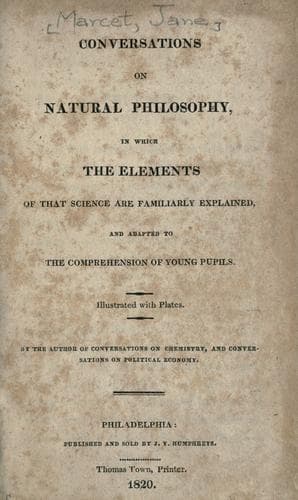
Conversations on Natural Philosophy, in which the Elements of that Science are Familiarly Explained — John Shaqi
Conversations on Natural Philosophy, in which the Elements of that Science are Familiarly ExplainedMarcet, Mrs. (Jane Haldimand)
Science
Conversations on Natural Philosophy, in which the Elements of that Science are Familiarly Explained
Marcet, Mrs. (Jane Haldimand)
Physics
66. (Pg. 45) If you make an elastic ball strike a body at right angles,
how will it return?
67. (Pg. 45) How if it strikes obliquely?
68. (Pg. 45) Explain by fig. 4 what is meant by the angles of incidence
and of reflection.
CONVERSATION IV.
ON COMPOUND MOTION.
COMPOUND MOTION, THE RESULT OF TWO OPPOSITE FORCES. OF CURVILINEAR
MOTION, THE RESULT OF TWO FORCES. CENTRE OF MOTION, THE POINT AT REST
WHILE THE OTHER PARTS OF THE BODY MOVE ROUND IT. CENTRE OF MAGNITUDE,
THE MIDDLE OF A BODY. CENTRIPETAL FORCE, THAT WHICH IMPELS A BODY
TOWARDS A FIXED CENTRAL POINT. CENTRIFUGAL FORCE, THAT WHICH IMPELS A
BODY TO FLY FROM THE CENTRE. FALL OF BODIES IN A PARABOLA. CENTRE OF
GRAVITY, THE POINT ABOUT WHICH THE PARTS BALANCE EACH OTHER.
MRS. B.
I must now explain to you the nature of compound motion. Let us suppose
a body to be struck by two equal forces in opposite directions, how will
it move?
_Emily._ If the forces are equal, and their directions are in exact
opposition to each other, I suppose the body would not move at all.
_Mrs. B._ You are perfectly right; but suppose the forces instead of
acting upon the body in direct opposition to each other, were to move in
lines forming an angle of ninety degrees, as the lines Y A, X A, (fig.
5. plate 2.) and were to strike the ball A, at the same instant; would
it not move?
_Emily._ The force X alone, would send it towards B, and the force Y
towards C; and since these forces are equal, I do not know how the body
can obey one impulse rather than the other; and yet I think the ball
would move, because as the two forces do not act in direct opposition,
they cannot entirely destroy the effect of each other.
_Mrs. B._ Very true; the ball therefore will not follow the direction of
either of the forces, but will move in a line between them, and will
reach D in the same space of time, that the force X would have sent it
to B, and the force Y would have sent it to C. Now if you draw two
lines, one from B, parallel to A C, and the other from C, parallel to A
B, they will meet in D, and you will form a square; the oblique line
which the body describes, is called the diagonal of the square.
_Caroline._ That is very clear, but supposing the two forces to be
unequal, that the force X, for instance, be twice as great as the force
Y?
_Mrs. B._ Then the force X, would drive the ball twice as far as the
force Y, consequently you must draw the line A B (fig. 6.) twice as long
as the line A C, the body will in this case move to D; and if you draw
lines from the points B and C, exactly as directed in the last example,
they will meet in D, and you will find that the ball has moved in the
diagonal of a rectangle.
_Emily._ Allow me to put another case. Suppose the two forces are
unequal, but do not act on the ball in the direction of a right angle,
but in that of an acute angle, what will result?
Public-domain text, read in full here on John Shaqi.
Reviews
Reviews
No reviews yet
Be the first to share your thoughts on this work.
Join the Discussion
Join the discussion
Sign in to leave a comment or review.
Sign InorCreate an account