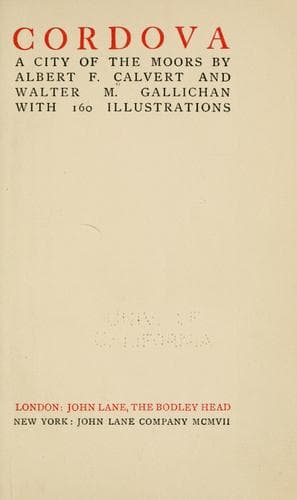
Cordova: A city of the MoorsCalvert, Albert Frederick
History
Cordova: A city of the Moors
Calvert, Albert Frederick
Arabs -- Spain; Córdoba (Spain) -- Description and travel; Córdoba (Spain) -- History
The moralist and philosopher was a delicate, ailing child, and
throughout his life he suffered from ill-health, which was increased by
his severe studies, and possibly by his asceticism. Seneca was one of
the first strenuous advocates of the vegetarian diet and ‘the simple
life.’ It is said that he subsisted upon the plainest fare and practised
rigorous self-denial.
There is much that is admirable in the character of Seneca, but there
are also traits that appear extremely incompatible with his constant
insistence upon right conduct and purity of life.
The genius of Seneca was soon recognised by the rulers in Cordova, and
his fame reached Rome, whither he went, and where he was received with
the respect that his deep learning merited. His career was, however,
checked by his unfortunate intrigue with Julia, the married sister of
the Emperor Caligula. As a punishment for his adultery he was sent to
Corsica, where he lived in banishment for eight years.
During this long spell of solitude Seneca mused and studied, and found
the period of exile one of fruitfulness to the mind. Yet when he was
recalled to Rome, at the intercession of Agrippina, the philosopher
exhibited a keen desire for wealth, which is scarcely reconcilable with
his affirmations concerning the life of simplicity and self-denial. In
order to make money, he did not hesitate to lend sums at an exorbitant
interest. He became a courtier, and was the confidential tutor of Nero;
but at the height of his fortune he conspired against the emperor. His
condonation of Nero’s murder of his mother was an elaborate piece of
casuistry, devised for no other reason than the desire to retain the
royal patronage. In this and in other episodes, the career of Seneca
bewilders us, and provides matter for reflection upon the inconsistency
of human nature and the fallibility of even the greatest ethicists.
The last pages in the life of the philosopher are sad. He was condemned
to death as a traitor, and he had married a young wife. When he heard
that the guards were on their way to arrest him, Seneca resolved to open
one of his veins and to bleed to death. His loyal and loving wife begged
to share his fate, and at her request he cut one of her veins. But
Seneca was old, seventy years of age, and his blood flowed so slowly
that he could not die. In his desperation he drank a cup of hemlock,
hoping to poison himself, and by that means put an end to his anguish.
Yet even the hemlock potion failed. Asphyxiation in a heated chamber at
last brought death to the aged sage, and by timely attention the life of
his young wife was saved.
Public-domain text, read in full here on John Shaqi.
Reviews
Reviews
No reviews yet
Be the first to share your thoughts on this work.
Join the Discussion
Join the discussion
Sign in to leave a comment or review.
Sign InorCreate an account