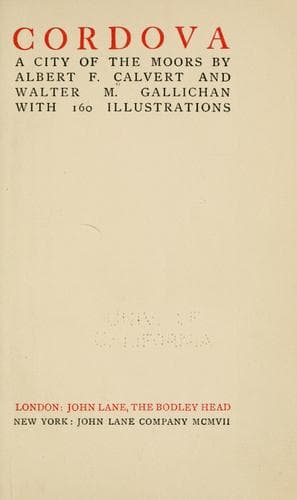
Cordova: A city of the MoorsCalvert, Albert Frederick
History
Cordova: A city of the Moors
Calvert, Albert Frederick
Arabs -- Spain; Córdoba (Spain) -- Description and travel; Córdoba (Spain) -- History
Marcus Annæus Lucanus, or Lucan, was born in Cordova in the year A.D. 38
or 39. He was the nephew of Seneca, and his father was a public servant
held in esteem in the city. Our data for a biography of Lucanus are very
scanty. He wrote poems before he left Cordova, and encouraged the
writing of Latin verse among the Spanish residents. His great work, the
_Pharsalia_, was left unfinished.
Lucan was lauded by Tacitus as a poet. He went to Rome, and it is
recorded that he vanquished Nero in one of the poetical tournaments in
which that monarch delighted. The egotistic emperor never forgave Lucan
for beating him in this literary contest. He vindictively forbade the
poet to write any more poems or to recite to audiences. We need not be
surprised that the aggrieved poet rebelled against this attempt to
utterly silence his song, to deprive him of the exercise of his art, and
to crush him. Lucan was aroused. He became one of the conspirators of
Piso, and plotted against the power of Nero.
When he was arrested, and offered pardon if he would name his
accomplices in the plot, Lucan falsely accused his mother Atilia of
complicity. This cowardly resort was, however, of no avail. He was not
spared by the vengeful Nero, who gave the poet his choice of death.
Lucan chose the usual Roman mode of opening a vein in a bath. He is said
to have recited one of his poems as he died.
Ibn-Roshid Averroes, the most renowned of the Arabian philosophers, was
born in Cordova in A.D. 1120. He came of a high-born family held in
honour in the city. His grandfather was a Kadi of Cordova. In his youth
Averroes learned law, mathematics, theology, and the practice of
medicine. His reputation as a man of erudition and of force of intellect
caused Almanzor to grant him privileges. He was appointed Kadi of the
city of Seville.
The story of the life of Averroes is an example of the eternal conflict
between the reformer of thought and morals and the mass of the people of
his age. Averroes was misunderstood, impeached as a dangerous heretic,
and condemned as an enemy of humanity. The Moors, in spite of their
culture, could manifest rank fanaticism when they encountered any
teaching that seemed to contradict the writings of the Koran, or the
traditional piety. Averroes was a follower of Aristotle, although he
remained a Mohammedan, and as the Greek philosophy did not accord
completely with the dogmas of Mohammed, the teacher was arraigned as an
assailant of religion and a foe to morality. His ostracism was thorough.
The noble man was pelted with stones by boys in the street, and scorned
by the whole city.
Public-domain text, read in full here on John Shaqi.
Reviews
Reviews
No reviews yet
Be the first to share your thoughts on this work.
Join the Discussion
Join the discussion
Sign in to leave a comment or review.
Sign InorCreate an account