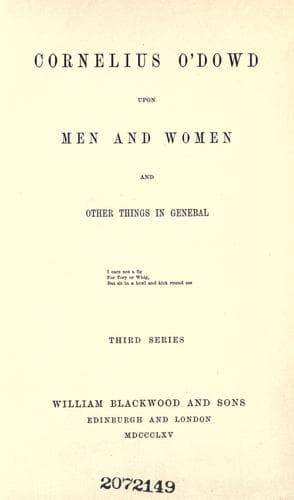
Cornelius O'Dowd Upon Men And Women And Other Things In GeneralLever, Charles
General
Cornelius O'Dowd Upon Men And Women And Other Things In General
Lever, Charles
Biography -- Humor; Essays; Italy -- Description and travel
F.’s face beamed over with ecstasy. It was one of the grand moments of
his life; and if he could, hungry as he was, he would have prolonged it!
To be there the guest of her Majesty’s mission; to know, to feel, that
the arms of England were over the door! that he was to be waited on
by flunkies in the livery of the Legation, fed by the cook who had
ministered to official palates, his glass filled with wine from
the cellar of him who represented royalty! These were very glorious
imaginings; and little wonder that F., whose whole life was a Poem in
its way, should feel that they almost overcame him. In fact, like the
woman in the nursery song, he was ready to exclaim, “This is none of
me!” but still there were abundant evidences around him that all was
actual, positive, and real.
“By the way,” said L., in a light, careless way, “did you ever in your
wanderings chance upon a namesake of yours, only that he interpolates
another Christian name, and calls himself R. Napoleon F.?”
The stranger started: the fresh, ruddy glow of his cheek gave way to
a sickly yellow, and, rising from his chair, he said, “Do you mean to
‘split’ on me, sir?”
“I’m afraid, F.,” said the other, jauntily, “the thing looks ugly. You
are R. N. F.!”
“And are you, sir, such a scoundrel--such an assassin--as to ask a man
to your table in order to betray him?”
“These are strong epithets, F., and I’ll not discuss them; but if you
ask, Are you going to dine here today? I’d say, No. And if you should
ask, Where are, you likely to pass the evening? I’d hint, In the city
jail.”
At this F. lost all command over himself, and broke out into a torrent
of the wildest abuse. He was strong of epithets, and did not spare
them. He stormed, he swore, he threatened, he vociferated; but L.,
imperturbable throughout all, only interposed with an occasional mild
remonstrance--a subdued hint--that his language was less than polite or
parliamentary. At length the door opened, two gendarmes appeared, and N.
F. was consigned to their hands and removed.
The accusations against him were manifold; from before and since the day
of the governesses, he had been living a life of dishonesty and fraud.
German law proceedings are not characterised by any rash impetuosity;
the initial steps in F.’s case took about eighteen months, during which
he remained a prisoner. At the end of this time the judges discovered
some informality in his committal; and as L. was absent from Munich,
and no one at the Legation much interested in the case, the man was
liberated on signing a declaration--to which Bavarian authorities,
it would seem, attach value--that he was “a rogue and a vagabond;”
confessions which the Captain possibly deemed as absurd an act of
“surplusage” as though he were to give a written declaration that he was
a vertebrated animal and a biped.
Public-domain text, read in full here on John Shaqi.
Reviews
Reviews
No reviews yet
Be the first to share your thoughts on this work.
Elsewhere in the archive
Join the Discussion
Join the discussion
Sign in to leave a comment or review.
Sign InorCreate an account