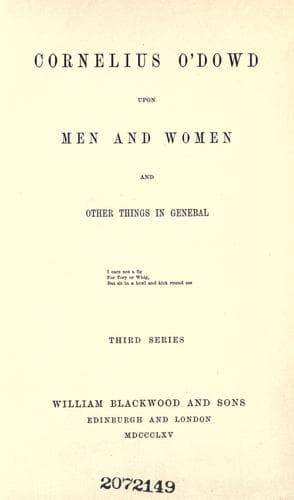
Cornelius O'Dowd Upon Men And Women And Other Things In GeneralLever, Charles
General
Cornelius O'Dowd Upon Men And Women And Other Things In General
Lever, Charles
Biography -- Humor; Essays; Italy -- Description and travel
In the ingenuity of his manifold devices even religion has not escaped
him, and it would be impossible to count how often he has left the
“Establishment” for Rome, been converted, reconverted, reconciled, and
brought home again--always, be it noted, at the special charge of so
much money from the Church Fund, or a subscription from the faithful,
ever zealous and eager to assist a really devout and truly sincere
convert!
That this man is an aspiring and ambitious vagabond may be seen in the
occasional raids he makes into the very best society, without having, at
least to ordinary eyes, anything to obtain in these ventures, beyond the
triumph of seeing himself where exposure and detection would be
certain to be followed by the most condign punishment. At Rome, for
instance--how, I cannot say--he obtained admission to the Duc de
Grammont’s receptions; and at Florence, under the pretext of being
a proprietor, and “a most influential” one, of the ‘Times,’ he
breakfasted, by special invitation, with Baron Ricasoli, and had a long
and most interesting conversation with him as to the conditions--of
course political--on which he would consent to support Italian unity.
These must have been done in pure levity; they were imaginative
excursions, thrown off in the spirit of those fanciful variations great
violinists will now and then indulge in, as though to say, “Is there a
path too intricate for me to thread, is there a pinnacle too fine for me
to balance on?”
A great deal of this fellow’s long impunity results from the shame men
feel in confessing to have been “done” by him. Nobody likes the avowal,
acknowledging, as it does, a certain defect in discrimination, and a
natural reluctance to own to having been the dupe of one of the most
barefaced and vulgar rogues in Europe.
There is one circumstance in this case which might open a very curious
psychological question; it is this: F.’s victims have not in general been
the frank, open, free-giving, or trustful class of men; on the contrary,
they have usually been close-fisted, cold, cautious people, who
weigh carefully what they do, and are rarely the dupes of their own
impulsiveness. F. is an Irishman, and yet his successes have been
far more with English--ay, even with Scotchmen--than with his own
countrymen.
In part this may be accounted for by the fact that F. did not usually
present himself as one in utter want and completely destitute; his
appeal for money was generally made on the ground of some speculation
that was to repay the lender; it was because he knew “something to
your advantage” that he asked for that £10. He addressed himself, in
consequence, to the more mercantile spirit of a richer community--to
those, in fact, who, more conversant with trade, better understood the
meaning of an investment.
Public-domain text, read in full here on John Shaqi.
Reviews
Reviews
No reviews yet
Be the first to share your thoughts on this work.
Elsewhere in the archive
Join the Discussion
Join the discussion
Sign in to leave a comment or review.
Sign InorCreate an account