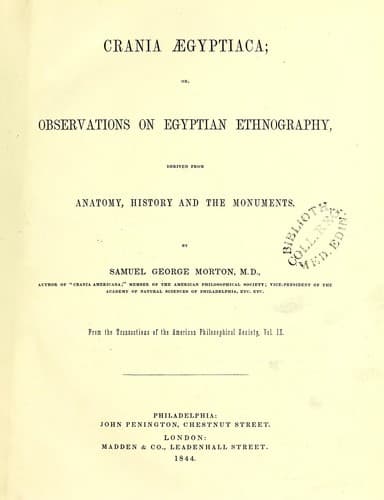
Crania Ægyptiaca: Or, Observations on Egyptian Ethnography Derived from Anatomy, History and the MonumentsMorton, Samuel George
History
Crania Ægyptiaca: Or, Observations on Egyptian Ethnography Derived from Anatomy, History and the Monuments
Morton, Samuel George
Craniology -- Egypt; Ethnology -- Egypt
This view of the case at once reconciles the remark of Champollion,
Rosellini, Heeren and Rüppell, that they could detect the present
Nubian physiognomy every where on the monuments; but at the same time
it supersedes the necessity of their inference that Nubia was the
cradle of civilization, and that the arts, descending the river, were
perfected in Egypt. The latter question cannot be definitively settled
until the archæologists decide on the relative antiquity of the
Egyptian and Nubian monuments. In the present state of the discussion,
however, the preponderance of facts is greatly in favour of Egypt.[59]
Without attempting to discuss this intricate question on the present
occasion, I will merely add my conviction that the original Meröites
were neither Arabs nor Hindoos, (although, as we shall explain, they
became greatly modified by these nations in after time) but that they
formed an unequivocal link in the Libyan chain of primitive Caucasian
nations.
THE FELLAHS.—These people, also called Arab-Egyptians, are found every
where in the valley of the Nile, of which they are the principal
cultivators. “Their heads,” observes Mr. Lane, “are a fine oval, the
forehead of moderate size, not high, but generally prominent; their
eyes are deep sunk, black and brilliant; the nose is straight and
rather thick; the mouth well formed; the lips are rather full than
otherwise; the teeth particularly beautiful, and the beard is commonly
black and curly, but scanty.”[60] They have a yellowish complexion,
and are, in general, a strong, well formed people. There can be little
question that the Fellahs are a mixture of the Arab stock with the old
rural population of Egypt; an amalgamation which dates chiefly from
the seventh century of our era, (A. D. 640,) when the Saracens under
Amrou conquered the country, and separated it from the Greek empire.
The constant influx of Arab population from that time to the present
must have more or less modified the features of the previous
inhabitants; and yet even now we are assured by Jomard and others,
that the Fellahs of upper Egypt present a striking resemblance, in all
respects, to the monumental paintings and sculptures. “A l’aspect des
hommes du territoire d’Esné, d’Ombos, ou d’Edfoû, ou des environs de
Selsélé, il semblerait (pour emprunter une image du plus célèbre des
ecrivains modernes) que les figures des monuments de Latopolis,
d’Ombos, ou d’Apollinopolis Magna, se sont détachées des murailles, et
sont descendues dans la campagne.”[61]
Public-domain text, read in full here on John Shaqi.
Reviews
Reviews
No reviews yet
Be the first to share your thoughts on this work.
Elsewhere in the archive
Join the Discussion
Join the discussion
Sign in to leave a comment or review.
Sign InorCreate an account