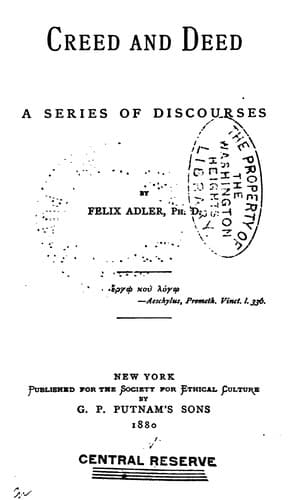
Creed and Deed: A Series of Discourses — John Shaqi
Creed and Deed: A Series of DiscoursesAdler, Felix
Religion
Creed and Deed: A Series of Discourses
Adler, Felix
Ethical culture movement; Ethics; Religion
Let us consider for a moment, in order to illustrate our meaning, the
life of one such priest, whose fame has come down to us undimmed by the
corroding influence of time--the life of Socrates. He held no office, he
ministered at no shrine, yet he was in the true sense a priest. A plain
unpretentious man, content to live on coarse fare, inured to want,
homely in appearance, using homely language; nothing had he in
appearance to attract; yet the gay youths left their feasts and frolics
when he approached, and the busy market-place was hushed to listen
to the strange wisdom of his sayings; there was indeed a singular and
potent charm in this man's soul. He had a great need of righteousness,
wonderful, how he awakened the same need in the hearts of the Athenian
burghers of his day. He was the reverse of dogmatic. In comparison with
the vastness of the unknown, he was wont to say, all human knowledge
is little even to nothingness, he did not assume to know the truth, but
strove to assist men in finding truths for themselves. He had his own
enlightened views on questions of theology. But far from desiring to
convert others to his convictions, he rather sought to divert their
attention from those mysterious problems, in which men can never be
wise, problems that are no nearer their solution today, than they were
two thousand years ago. To those who questioned him concerning religion
he replied: Are ye then masters of the humanities, that ye seek to pry
into divine secrets? His father had been a fashioner of statues before
him, he was a fashioner of souls! This Socrates was condemned to suffer
death on the charge of atheism, and met his fate with the calmness of
the philosophic mind. If death, he said, is progress to untried spheres,
then welcome death! If it is sleep only, then also welcome death and its
deep repose. All the tokens of the priest were fulfilled in him. He was
true to himself and unbared to others the veiled truths of their own
higher nature. He was a loftier presence on earth, a living flame fed
from its own central being, a sun to which the world turned and was
thereby enlightened. We perceive then, that what we desire is not a new
thing. There has been this service of the Ideal from the earliest times.
Only a new plea would we urge for larger fidelity to that which the best
have striven for, and which under new conditions it will be the glory of
our age to approach more nearly.
Public-domain text, read in full here on John Shaqi.
Reviews
Reviews
No reviews yet
Be the first to share your thoughts on this work.
Join the Discussion
Join the discussion
Sign in to leave a comment or review.
Sign InorCreate an account