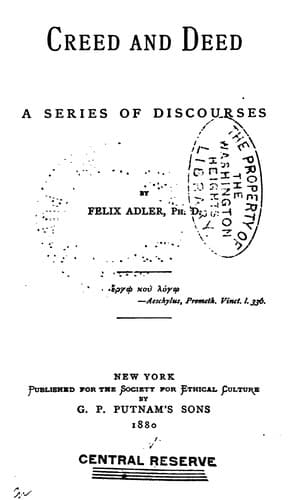
Creed and Deed: A Series of DiscoursesAdler, Felix
Religion
Creed and Deed: A Series of Discourses
Adler, Felix
Ethical culture movement; Ethics; Religion
The new Ideal is progressive. Whatever we have achieved, it tells us
there are larger achievements yet beyond. As we rise in the scale of
moral worth, the eye becomes clearer and wider of vision. We see in
remote ages a race of men freer and stronger because of our toils, and
that is our dearest hope and our sweetest recompense that they shall
reap what we have sown.
The old and the new Ideals will struggle for the mastery; that which is
stronger will conquer as of old, in the struggle for existence. But the
new hope fills us with trust and gladness that that which is true will
be strong.
IV. THE PRIESTS OF THE IDEAL
It is with good reason, that the very name of the priesthood, has become
odious to the modern mind. How has their fanaticism drenched the earth
with blood, how has their unbridled ambition sown seeds of discord
among the nations; how lamentable a commentary is the record of their
frailties upon the assumption of superior sanctity and God-given
authority. Yet it is not the priestly office, but its abuse, which has
proved of evil, nor has the time yet come, when the ministry of priests
can be safely dispensed with. There shall come a new Ideal to attract
men's reverence and a new service of the Infinite and a new priesthood
also to do its ministry. It is of this modern priesthood, I would speak.
Fear not that I am about to advocate a return to that system of
spiritual bondage, from which we have but just escaped. The priests to
whom we allude shall not be known by cassock or surplice. It is not
at the altar they shall serve, least of all shall they have dogmas to
communicate. They shall not be more than human, only if possible more
human. Priests have we of science, we name them so; men whose whole soul
is wrapped up in the pursuit of knowledge: priests of art, who dedicate
their lives to the service of the Beautiful, priests also of the Moral,
artists of the Good, sages in the science of Virtue, teachers of the
Ideal.
Public-domain text, read in full here on John Shaqi.
Reviews
Reviews
No reviews yet
Be the first to share your thoughts on this work.
Join the Discussion
Join the discussion
Sign in to leave a comment or review.
Sign InorCreate an account