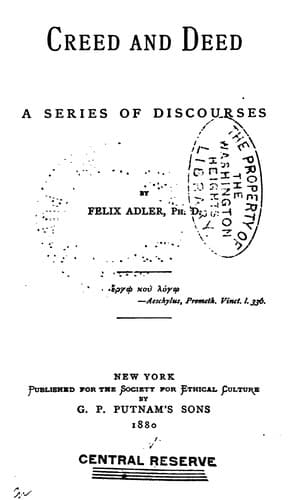
Creed and Deed: A Series of DiscoursesAdler, Felix
Religion
Creed and Deed: A Series of Discourses
Adler, Felix
Ethical culture movement; Ethics; Religion
When we build a house, it shall not be for its uses only. We shall have
kitchens and drawing rooms and libraries and pictures and flowers, if
possible. But the house, with all its comforts and luxuries, is mere
framework, and our words and doings construct the true, the spiritual
home. When we sit down to table, it shall not be for the use of the
food and the flavor of the wine only, but morality should preside at the
feast and lend it grace and dignity. Morality does not mope in corners,
is not sour nor gloomy. It loves genial fellowship, loves to convert
our meanest wants into golden occasions for joy and sympathy and happy
communion. Manners too are the offspring of character. We do not rate
highly the dry and cheerless conventionalisms of etiquette, but in
their origin, they were the fruit of truth, and love. The rules of good
breeding may be reduced to two; self-possession and deference. As when
a public speaker loses his self-control, his own uncertainty is quickly
communicated to his audience, and he forfeits his influence over his
hearers; so the same cause produces the same effect in every lesser
audience that gathers in our parlors. Society says to you: If I shall
trust you, you must begin by trusting yourself. The man of the world
will enter the palace of the prince and the cottage of the peasant with
the same equipoise of manner. If he respects himself, there is no
reason why he should stand abashed. Self-possession is essentially
self-respect. Deference, too, is a primary condition of all courtesy.
It teaches us to concede to others whatever we claim for ourselves; it
leads us instinctively to avoid loudness, and self-complacency. It is
expressed not only in the polished phrase, but in mien, attitude, every
movement. Self-possession and deference of manner are both the outgrowth
of moral qualities, the one depending on the consciousness of personal
worth, the other inspired by an unselfish regard for the well-being of
others. From these two it were possible to deduce the rules of a
new 'Chesterfield,' which should be free from all the conceit and
affectation of the old. Unfortunately, manners are no longer the natural
outpouring of heart-goodness. Men attire themselves in politeness as
they do in rich apparel; they may be as rude as they please, the year
round, they know they can be fine on occasion. Moreover in the home
circle, where the forms of courtesy are quite indispensable to prevent
undue friction; to send the light of grace and poetry into a world of
little cares; to fill the atmosphere of our daily surroundings as
with the fragrance of a pervading perfume; they are yet most commonly
neglected. The word manners has the same meaning as morals. When we
shall have better morals, we shall have truer and sweeter manners.
Public-domain text, read in full here on John Shaqi.
Reviews
Reviews
No reviews yet
Be the first to share your thoughts on this work.
Join the Discussion
Join the discussion
Sign in to leave a comment or review.
Sign InorCreate an account