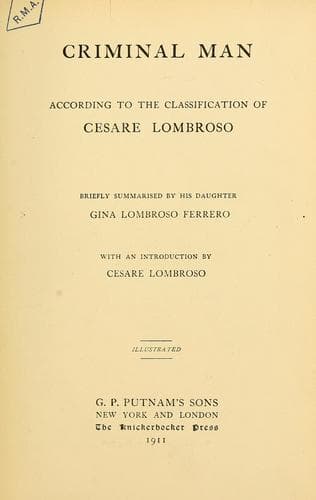
Criminal Man, According to the Classification of Cesare LombrosoLombroso, Gina
Science
Criminal Man, According to the Classification of Cesare Lombroso
Lombroso, Gina
Criminal anthropology; Criminology
Samt describes a still more complicated form of this psychic seizure, in
which the personality is altered without there being any loss of
consciousness. In a case of this kind, a servant, after forty years of
faithful service, murdered his old mistress during the night, having
previously cut all the bell-wires to prevent communication with the
other servants. He escaped with some valuables, but returned in a few
days and gave himself up to the police, to whom he gave a detailed
account of his crime without showing either horror or remorse. He was
tried and condemned, and a few months later was again seized with
epileptic fits during one of which he died. Samt, who saw him in this
state, came to the conclusion that the murder had been committed during
a similar seizure and he was able to prove that attacks of this kind are
not necessarily accompanied by loss of consciousness.
As in the above case, these psychic attacks are sometimes accompanied by
an insatiable thirst for blood, destruction and violence of all kinds,
as well as by an extraordinary development of muscular strength with
apparent lucidity of mind. They may last from a few minutes to half an
hour, after which the patient falls into a sound sleep and forgets
everything that has happened, or else retains only a vague recollection.
Such was the case of the epileptic Misdea, which first suggested to my
father the idea of a link between crime and epilepsy. As this case has
become famous in the annals of crime in Italy, it will perhaps be of
interest to the reader. Misdea, the son of degenerate parents,
manifested a series of typical epileptic anomalies--asymmetry,
vaso-motor disturbances, impulsiveness, ferocity, etc. At the age of
twenty, while serving in the army, for some trivial motive he suddenly
attacked and killed his superior officer and eight or ten soldiers who
tried to overpower him. Finally he was bound and placed in a cell, where
he fell into a sound slumber and on awaking had entirely forgotten what
he had done. He was condemned to death, but my father, who examined him
medically, was able to prove conclusively that the crime had been
committed during an attack of epilepsy.
The physical and psychic characters of this class of epileptic are those
common to all non-criminal epileptics, and indeed we are justified in
considering them insane rather than criminal, because, with the
exception of the attack, which assumes this terrible form, they do not
manifest criminal tendencies.
HYSTERIA
Hysteria is a disease allied to epilepsy, of which it appears to be a
milder form, and is much more common among women than men in the ratio
of twenty to one. The disease may frequently be traced to hereditary
influences, similar to those found in epilepsy, transmitted by
epileptic, neurotic, or inebriate parents, frequently also, to some
traumatic or toxic influence, such as typhus, meningitis, a blow, a
fall, or fright.
Public-domain text, read in full here on John Shaqi.
Reviews
Reviews
No reviews yet
Be the first to share your thoughts on this work.
Join the Discussion
Join the discussion
Sign in to leave a comment or review.
Sign InorCreate an account