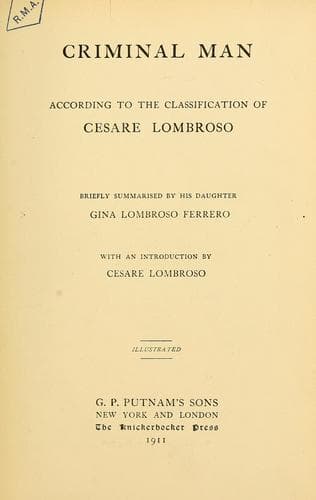
Criminal Man, According to the Classification of Cesare LombrosoLombroso, Gina
Science
Criminal Man, According to the Classification of Cesare Lombroso
Lombroso, Gina
Criminal anthropology; Criminology
But the most characteristic case, which aroused much interest in its
time, is that of Olivo. He was a man of handsome appearance, with normal
olfactory acuteness and sensibility to touch and pain. He had, however,
inherited from neurotic and insane forebears secondary epileptic
phenomena, which subsequently developed into convulsive epilepsy, and
certain indications of degeneracy (facial and cranial asymmetry,
abnormal capillary vortices and length of arm, scotoma in the field of
vision and exaggerated tendinous reflex action). Up to the age of
thirty he led an irreproachable life; in fact, he was scrupulous to
excess, and this, coupled with pronounced conceit and stinginess, was
his only fault. He married a woman of common origin, who was not really
depraved, but she was coarse and unfaithful, and, worst of all in his
eyes, unscrupulous and wasteful. These defects, and her habits of lying
and trickery embittered the poor man's existence. One night, feeling
very ill, probably owing to an approaching seizure, he appealed to his
wife for assistance and received an unfeeling reply, whereupon he sprang
out of bed, picked up a knife and stabbed her. Afterwards he fell into a
deep sleep. In order to obliterate all traces of the crime, he cut the
corpse into small pieces, packed it into a portmanteau and threw it into
the sea. Two months later, when he was arrested, he immediately made a
full confession, showing deep repentance and sincere attachment to his
victim, whose merits he celebrated in a poem of his own composition. At
the trial, he made no attempt to defend himself; during the hearing of
evidence, which appeared greatly to agitate him, he was seized with an
epileptic fit. He was absolved by the jury and returned to his former
peaceful occupation of bookkeeper, nor did he again come into conflict
with the law.
_Reluctance to Commit Crimes._ Another trait characteristic of
criminaloids is the hesitation they show before committing a crime,
especially the first time, when it is not done, as in the above
mentioned case, during an epileptic seizure.
Feuerbach's fine collection contains a description of the brothers
Kleinroth, whose father cruelly ill-treated and starved his wife and
family while lavishing his money on low women and their bastards. The
sons were unwilling to run away and leave the invalid mother to bear the
brunt of her husband's fury, and while they were in this terrible
situation, a certain individual offered to assassinate their tormentor.
After great hesitation this offer was accepted; when arrested, the
youths immediately confessed their complicity and manifested deep
repentance.
_Confession._ The criminaloid is easily induced to confess his misdeed.
Public-domain text, read in full here on John Shaqi.
Reviews
Reviews
No reviews yet
Be the first to share your thoughts on this work.
Elsewhere in the archive
Join the Discussion
Join the discussion
Sign in to leave a comment or review.
Sign InorCreate an account