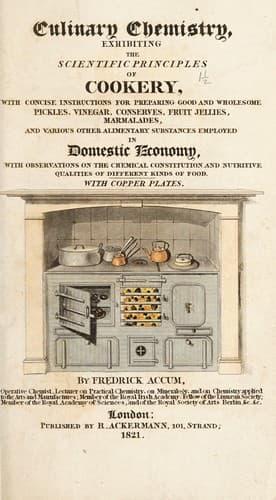
Culinary Chemistry: The Scientific Principles of Cookery, with Concise Instructions for Preparing Good and Wholesome Pickles, Vinegar, Conserves, Fruit Jellies, Marmalades, and Various Other Alimentary Substances Employed in Domestic Economy, with Observations on the Chemical Constitution and Nutritive Qualities of Different Kinds of Food. — John Shaqi
Culinary Chemistry: The Scientific Principles of Cookery, with Concise Instructions for Preparing Good and Wholesome Pickles, Vinegar, Conserves, Fruit Jellies, Marmalades, and Various Other Alimentary Substances Employed in Domestic Economy, with Observations on the Chemical Constitution and Nutritive Qualities of Different Kinds of Food.Accum, Friedrich Christian
Science
Culinary Chemistry: The Scientific Principles of Cookery, with Concise Instructions for Preparing Good and Wholesome Pickles, Vinegar, Conserves, Fruit Jellies, Marmalades, and Various Other Alimentary Substances Employed in Domestic Economy, with Observations on the Chemical Constitution and Nutritive Qualities of Different Kinds of Food.
Accum, Friedrich Christian
Cooking; Food poisoning
If the stew-pan be close shut, it is evident that none of the nutritive
principles can escape, and must either be found in the meat itself or in
the liquid. The water or gravy in which the meat is stewed, being
capable of dissolving the gelatine and albumen, the greater part of them
become separated during the simmering process. Now, since the firm
texture of the bundles of fibres of the meat is owing to the solid
gelatine and albumen glueing them, as it were, together, when they are
dissolved and disengaged, the meat must become greatly disorganized.
These principles, as well as the fat and osmazome, are partly disengaged
from the meat, and become united with the gravy. It is to these, indeed,
that the gravy owes all its richness and excellence. The muscular
fibres and the tendons acquire a gluey appearance and texture, and the
whole forms a savoury gelatinous _stew_, _gravy_, or _soup_.
No scorching or browning of the meat takes place if the process is
properly conducted; for the temperature to which it is exposed does not
exceed the boiling point of water.
In the stewing of vegetables, saccharine matter is formed, the starch
and mucilage are rendered soluble, and of course, set free the woody
fibre, which either floats through the liquid or adheres together very
slightly. It accordingly constitutes either a pasty fluid, or converts
the vegetables to a soft pulp; sometimes their original shape being
preserved entire, and at other times not.
BOILING.
Boiling is a much more common operation than any of those we have
considered, with the exception perhaps of roasting. It consists, as
every body knows, in subjecting the materials of food to the influence
of heat, through the medium of boiling water, or of steam.
The water employed for boiling meat or pulse should be soft, and the
joint should be put on the fire immersed in cold water, in order that
the heat may gradually cause the whole mass to become boiled equally.
If the piece of meat is of an unequal thickness, the thinner parts will
be over-done before the more massy portion is sufficiently acted on by
the boiling water.
Salted meat requires to be very slowly boiled, or simmered only, for a
quick and rapid ebullition renders salted provisions extremely hard.
Frozen substances should be thoroughly thawed, and this is best effected
by immersing them in cold water.
Count Rumford has taken much pains to impress on the minds of those who
exercise the culinary art, the following simple but pratical, important
fact, namely, that when water begins only to be agitated by the heat of
the fire, it is incapable of being made hotter, and that the violent
ebullition is nothing more than an unprofitable dissipation of the
water, in the form of steam, and a considerable waste of fuel.
Reviews
Reviews
No reviews yet
Be the first to share your thoughts on this work.
Join the Discussion
Join the discussion
Sign in to leave a comment or review.
Sign InorCreate an account