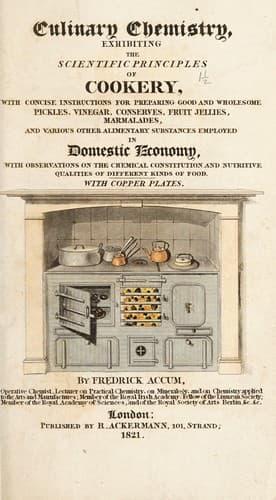
Culinary Chemistry: The Scientific Principles of Cookery, with Concise Instructions for Preparing Good and Wholesome Pickles, Vinegar, Conserves, Fruit Jellies, Marmalades, and Various Other Alimentary Substances Employed in Domestic Economy, with Observations on the Chemical Constitution and Nutritive Qualities of Different Kinds of Food. — John Shaqi
Culinary Chemistry: The Scientific Principles of Cookery, with Concise Instructions for Preparing Good and Wholesome Pickles, Vinegar, Conserves, Fruit Jellies, Marmalades, and Various Other Alimentary Substances Employed in Domestic Economy, with Observations on the Chemical Constitution and Nutritive Qualities of Different Kinds of Food.Accum, Friedrich Christian
Science
Culinary Chemistry: The Scientific Principles of Cookery, with Concise Instructions for Preparing Good and Wholesome Pickles, Vinegar, Conserves, Fruit Jellies, Marmalades, and Various Other Alimentary Substances Employed in Domestic Economy, with Observations on the Chemical Constitution and Nutritive Qualities of Different Kinds of Food.
Accum, Friedrich Christian
Cooking; Food poisoning
STEWING.
Stewing differs from roasting and broiling, in the heat being applied to
the substance through a small portion of a liquid medium; and, from
boiling and frying, in the process being conducted by means of an
_aqueous_, and not by means of an oily fluid. It is necessary that the
fire be moderate; for a strong heat suddenly applied would be very
injurious. The liquids employed as the medium for applying the heat are
usually water, gravy, or broth, the quantity of which must be such as
shall prevent the meat from burning and adhering to the pan. It is not
requisite that the liquid be made to boil in stewing. It should only be
raised nearly to a simmering heat, which will retard the fluid being
evaporated too quickly. The closeness of the vessel will also prevent
the waste of the liquid. If it diminish too quickly, it must, from time
to time, be replenished.
The management of the fire in cooking, is, in all cases, a matter of
importance, but in no case is it so necessary to be attended to as in
preparing stews or made dishes; not only the palatableness, but even the
strength or richness of all made dishes, seems to depend very much upon
the management of the heat employed in cooking them.
The most proper sorts of animal food for stewing, are such as abound in
fibrine, and which are too dry or too tough for roasting. When beef or
mutton is rather old and too coarse flavoured, and not tender enough for
the spit or the gridiron, it may, by stewing, be not only rendered
tolerably palatable, but even sometimes savoury and good. But the
stewing process is not confined to flesh of this sort; for veal and
other young flesh which abounds in gelatine, when properly stewed, is
much relished.
The vegetables most usually stewed are carrots, turnips, potatoes,
pease, beans, and other leguminous seeds. Some fruits are also cooked in
this way.
_Rationale._--Stewing is nothing else than boiling by means of a small
quantity of an aqueous fluid, and continuing the operation for a long
time to render the substance tender, to loosen its texture, to render
it more sapid, and to retain and concentrate the most essential parts of
animal or vegetable food.
Public-domain text, read in full here on John Shaqi.
Reviews
Reviews
No reviews yet
Be the first to share your thoughts on this work.
Join the Discussion
Join the discussion
Sign in to leave a comment or review.
Sign InorCreate an account