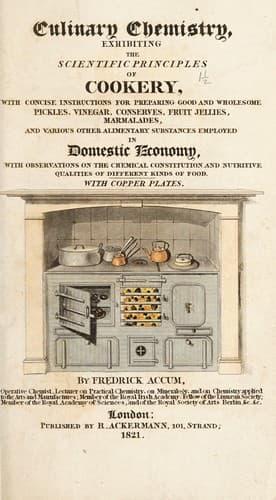
Culinary Chemistry: The Scientific Principles of Cookery, with Concise Instructions for Preparing Good and Wholesome Pickles, Vinegar, Conserves, Fruit Jellies, Marmalades, and Various Other Alimentary Substances Employed in Domestic Economy, with Observations on the Chemical Constitution and Nutritive Qualities of Different Kinds of Food.Accum, Friedrich Christian
Science
Culinary Chemistry: The Scientific Principles of Cookery, with Concise Instructions for Preparing Good and Wholesome Pickles, Vinegar, Conserves, Fruit Jellies, Marmalades, and Various Other Alimentary Substances Employed in Domestic Economy, with Observations on the Chemical Constitution and Nutritive Qualities of Different Kinds of Food.
Accum, Friedrich Christian
Cooking; Food poisoning
from becoming more soft and pulpy, they will become dry and juiceless.
If indeed the boiling point of the water be artificially increased above
212°, by pressure applied to the surface of the liquid, the fibres may
be reduced to a pulp, quite homogeneous. When this is done by Papin’s
digester, or by any other apparatus of the same kind, and when the
process under such circumstances is long continued, the hardest bones
may be converted into jelly.
It is only by boiling that the more gelatinous parts of flesh can be
completely extracted unaltered from such parts as are cartilaginous,
ligamentous, or tendinous.
COMPARISON OF THE CHEMICAL CHANGES PRODUCED ON ANIMAL AND VEGETABLE
FOOD, IN THE DIFFERENT PROCESSES OF COOKERY.
The principal operations of cookery which we have just examined and
explained, all agree in this, that they effect some chemical change on
the materials operated upon, by which they are rendered more digestible,
more wholesome, and consequently more nutritive.
In such of the operations as are performed by the direct application of
heat to the flesh of animals, namely, roasting, baking, frying, and
broiling, the meat loses the vapid and nauseous taste and odour which it
possesses in a raw state, and becomes savoury, juicy, and grateful to
the taste. These effects arise from the development of the gelatine and
osmazome from the smaller vessels, and their being rendered soluble;
while, at the same time a portion of the fat is liquified, and combines
with them after they are disengaged.
The fibres again, on the surface of the meat, are partly scorched, and
form a crust, which, except in the interstices of the corrugations, is
impermeable, and consequently prevents the savoury gravy that is
disengaged from the fibres from oozing out or becoming evaporated. It is
thus only disengaged from its chemical union with the fibres, and
remains mechanically united with them in the meat, after it is cooked,
as we see upon cutting into the fibrous portion.
The effect produced on the fat is somewhat different. The direct
application of fire to this portion of the meat soon melts part of the
substance, and raises it to the boiling point, or nearly so; the water
which it contains is consequently given off in the form of steam, and it
carries with it a quantity of osmazome. It is this which occasions the
peculiar odour that arises from meat while roasting.
Public-domain text, read in full here on John Shaqi.
Reviews
Reviews
No reviews yet
Be the first to share your thoughts on this work.
Join the Discussion
Join the discussion
Sign in to leave a comment or review.
Sign InorCreate an account