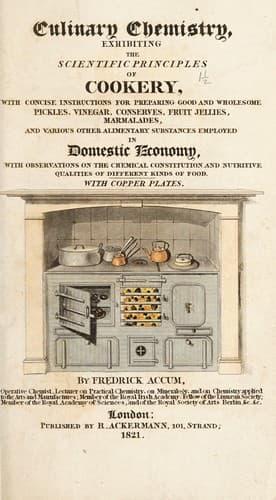
Culinary Chemistry: The Scientific Principles of Cookery, with Concise Instructions for Preparing Good and Wholesome Pickles, Vinegar, Conserves, Fruit Jellies, Marmalades, and Various Other Alimentary Substances Employed in Domestic Economy, with Observations on the Chemical Constitution and Nutritive Qualities of Different Kinds of Food.Accum, Friedrich Christian
Science
Culinary Chemistry: The Scientific Principles of Cookery, with Concise Instructions for Preparing Good and Wholesome Pickles, Vinegar, Conserves, Fruit Jellies, Marmalades, and Various Other Alimentary Substances Employed in Domestic Economy, with Observations on the Chemical Constitution and Nutritive Qualities of Different Kinds of Food.
Accum, Friedrich Christian
Cooking; Food poisoning
The vapid taste is also corrected by the empyreuma, combined with a
minute quantity of ammonia, which is soon developed on the surface of
the fat, by the partial charring--not of the fat itself, but of the
cellular membrane in which it is enveloped. This structure may easily be
perceived on a slight examination of a piece of recent fat; all the
membranous or skinny portions being only the receptacles or nests for
the fat itself. And since these membranes are for the most part
exceedingly thin and easily ruptured, and since heat increases the
volume of the fat which they contain, the application of heat in
roasting or broiling will soon make all the membranes burst which are
within its influence, and thus give a free passage for the juices to
unite with each other.
There is, according to these statements, but little loss of the
substance of meat when roasted or broiled, and the chemical changes
produced are so slight, that nearly all its nutritive elements must be
preserved and concentrated in the cooked meat.
When there is a watery medium used, through which heat is applied to
animal food, as for example, in the process of stewing or boiling, a
portion of the fat, gelatine, and osmazome, is dissolved, and mixes
with the water. Nutritive matter is consequently lost, or, at least, it
is transferred from the meat to the broth or soup.
In the operation of _stewing_ there is less of this transfer made; and,
besides, as the medium is scarcely kept at a boiling heat, less of the
nutritive juices are dissolved. When, however, the broth or gravy in
which meat is _boiled_ is made use of, as well as the meat itself,
boiling is the most economical practice; for though nothing be added
except the water, this itself, if it contains no nourishment, at least
fills the stomach, and serves to diffuse more widely the nutritive
juices of the meat which it holds in solution or in mixture.
But though boiling be thus the most economical practice, it is not
always to the taste of individuals, or even of whole nations to use the
broth or soup. The English and Irish, for example, rarely follow this
practice, while the Scots, French, and Germans, prefer it to all other
modes of cooking. In general, then, it should seem, that roasting as it
is the simplest, is also the best mode of rendering the flesh of animals
fit for human food. Roasted meat is wholesome and highly nourishing; and
when there is not too much of the empyreumatic crust formed, it is for
the most part easily digested. In these respects, broiled meat differs
little from such as is roasted. What is fried is always less tender. It
is often found that roasted or broiled meat sits more easily on the
stomach, and is sooner digested by those whose digestive organs are
feeble or diseased, than fried or boiled meat, or broths and stews.
Public-domain text, read in full here on John Shaqi.
Reviews
Reviews
No reviews yet
Be the first to share your thoughts on this work.
Join the Discussion
Join the discussion
Sign in to leave a comment or review.
Sign InorCreate an account