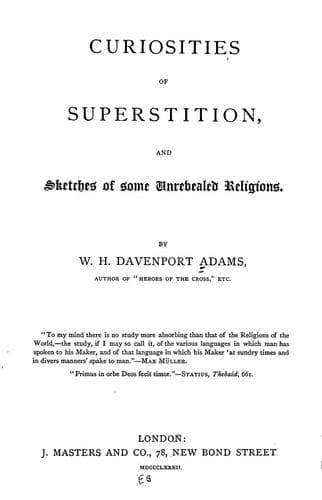
Curiosities of Superstition, and Sketches of Some Unrevealed ReligionsAdams, W. H. Davenport (William Henry Davenport)
Religion
Curiosities of Superstition, and Sketches of Some Unrevealed Religions
Adams, W. H. Davenport (William Henry Davenport)
Folklore; Religions; Superstition
We have spoken of Zarathustra’s religion as originally monotheistic; its
purity, however, was not long preserved, and the cause of its corruption
lay in itself. Zarathustra could not deny the existence of Evil, and to
explain it was driven to concoct an extraordinary hypothesis. As in every
electrified object there are two poles, a positive and a negative, so,
according to the Prophet, in Ahura-Mazda, and in all rational beings, man
included, are present a good and holy Will, and its shadow or negative,--a
higher and a lower nature,--the Positive and the Negative Mind. How
Zarathustra reconciled this idea with his conception of Ahura-Mazda, as
Perfect Goodness, we are unable to comprehend. At all events, it contained
the germs of the future Dualism of the Persian religion. The Negative Mind
soon came to be separated from the good and holy Will, and was quickly
personified as an independent evil being, a Power of Night and Darkness,
Ahriman (Angro-Manyus,) equal in might to Ahura-Mazda, and disputing with
him the possession of the world. Thus arose the myth of the constant
struggle between the two powers, as between Day and Night; the servants of
Ahura-Mazda being sent forth to encounter, resist, and overcome the slaves
and works of Ahriman, thereby bringing about the end of all things, when
Ahriman himself should be vanquished and reconciled.
In course of time the difficulties of this dual theory were detected by
acute intellects, and at the Sassanian Revival an attempt was made to
dispose of them by introducing the doctrine of Monotheism under a new
form, that of a Great Primal Cause (Zervana Akarana), the Boundless Time
or Uncreated Whole, such as we trace in the later Greek poetry, and
apparently rather a “metaphysical abstraction,” like the Greek Ἀνάγκη, or
the Roman Nemesis, than “an active and presiding deity.” Thence proceeded
both the Good and the Evil Principles; the two antagonist creators who
balanced against each other in perpetual conflict a race of spiritual and
material beings, light and darkness, good and evil. The wise benevolence
of Ahura-Mazda formed men capable of virtuous impulses, and endowed each
with everything that could contribute to his happiness. He preserved by
his watchful providence the harmonious movements of the planets, and the
temperate combination of the elements. But the malice of Ahriman has long
since pierced Ahura-Mazda’s “egg;” in other words, violated the sweet
accord and bounteous beauty of His works. Since that fatal irruption, the
most minute articles of good and evil are alternately commingled and
agitated together; the most poisonous herbs spring up among the most
wholesome plants; the warfare of deluges, earthquakes, and conflagrations
disturbs the serenity of nature; and humanity is subjected to all the
blighting influences of sin, suffering, and sorrow. While the rest of
mankind were led away captive in the chains of their terrible enemy, the
Public-domain text, read in full here on John Shaqi.
Reviews
Reviews
No reviews yet
Be the first to share your thoughts on this work.
Join the Discussion
Join the discussion
Sign in to leave a comment or review.
Sign InorCreate an account