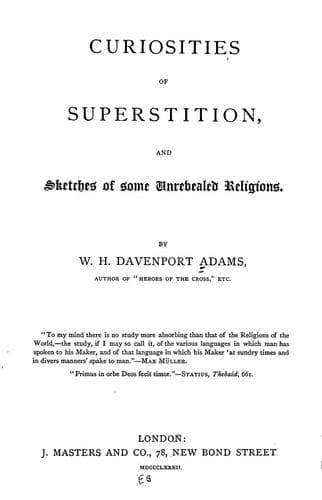
Curiosities of Superstition, and Sketches of Some Unrevealed ReligionsAdams, W. H. Davenport (William Henry Davenport)
Religion
Curiosities of Superstition, and Sketches of Some Unrevealed Religions
Adams, W. H. Davenport (William Henry Davenport)
Folklore; Religions; Superstition
faithful Persian alone remained constant in his faith in Ahura-Mazda, and
fought under his banner of light, looking forward to a triumphant day when
Good should prevail over all the world.
It seems to us impossible to doubt that, in this later development of the
Zoroastrian faith, its priests and teachers were largely indebted to the
Sacred Writings, though into what they borrowed they introduced much
original and fanciful speculation.
A Parsee, with a firm faith in Ahura-Mazda, and conscious of having obeyed
the law, offered up prayer and praise, and renounced, in intention at
least, evil thoughts and deeds and words, lay down on his death bed in a
certain hope and expectation of the Eternal life. We have seen that the
Zendavesta appointed a variety of penances, by the performance of which
the believer obtained immediate pardon for ordinary transgressions; and
therefore, full of the self-righteousness which his creed was so well
adapted to inculcate, he faced the passage of the Dark River without fear.
He knew not of any need to implore the mercy of a Redeemer, to humble
himself in sackcloth and ashes, to base his hope on the infinite love of
GOD made man, on the glorious sacrifice of the Cross; his soul passed
straight to Paradise, as an arrow flies towards its mark. In the Khordah
Avesta we can follow the stages of its journey:--On the first night after
death the soul dwelt near the head of the inanimate body it had just
deserted, and sat there praying, rejoicing in as much joy as is vouchsafed
to the whole living world. And so did it dwell on the second night,
praying. And so did it dwell on the third night, praying. But when the
third night verged upon dawn, the soul of the pure man went forward. A
wind, sweeter than all other winds, blew to meet it from the south. And in
that wind came to embrace the pilgrim _his own law_, under the figure of a
maiden beautiful and shining, fair as the fairest of created beings. The
pilgrim then took the first step in his celestial progress, and arrived in
the paradise _Hamata_; he took the second, and reached the paradise
_Hûkhta_; he took the third, and arrived at the paradise _Hvarsta_. The
beatified wanderer made yet another step, and gained the presence of the
Eternal Light. There was he addressed by an already beatified soul: “How
art thou, O pure deceased, who hast come from the perishable world hither
to the imperishable?” Ahura-Mazda here interrupted: “Ask him not, for he
has come on the fearful trembling way, the separation of soul and body.
Bring him hither of the food of the full fatness, that is, of the filling
food for those who think, speak, and do good, for the pure after death.”
Public-domain text, read in full here on John Shaqi.
Reviews
Reviews
No reviews yet
Be the first to share your thoughts on this work.
Join the Discussion
Join the discussion
Sign in to leave a comment or review.
Sign InorCreate an account