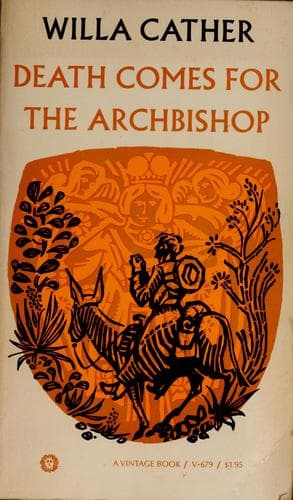
Christian fiction; Clergy -- Fiction; Historical fiction; New Mexico -- Fiction
At four o'clock they were on the road, Jacinto riding the mule that
carried the blankets. He knew the trails through his own mountains well
enough to follow them in the dark. Toward noon the Bishop suggested a
halt to rest the mules, but his guide looked at the sky and shook his
head. The sun was nowhere to be seen, the air was thick and grey and
smelled of snow. Very soon the snow began to fall--lightly at first, but
all the while becoming heavier. The vista of pine trees ahead of them
grew shorter and shorter through the vast powdering of descending
flakes. A little after midday a burst of wind sent the snow whirling in
coils about the two travellers, and a great storm broke. The wind was
like a hurricane at sea, and the air became blind with snow. The Bishop
could scarcely see his guide--saw only parts of him, now a head, now a
shoulder, now only the black rump of his mule. Pine trees by the way
stood out for a moment, then disappeared absolutely in the whirlpool of
snow. Trail and landmarks, the mountain itself, were obliterated.
Jacinto sprang from his mule and unstrapped the roll of blankets.
Throwing the saddle-bags to the Bishop, he shouted, "Come, I know a
place. Be quick, Padre."
The Bishop protested they could not leave the mules. Jacinto said the
mules must take their chance.
For Father Latour the next hour was a test of endurance. He was blind
and breathless, panting through his open mouth. He clambered over
half-visible rocks, fell over prostrate trees, sank into deep holes and
struggled out, always following the red blankets on the shoulders of the
Indian boy, which stuck out when the boy himself was lost to sight.
Suddenly the snow seemed thinner. The guide stopped short. They were
standing, the Bishop made out, under an overhanging wall of rock which
made a barrier against the storm. Jacinto dropped the blankets from his
shoulder and seemed to be preparing to climb the cliff. Looking up, the
Bishop saw a peculiar formation in the rocks; two rounded ledges, one
directly over the other, with a mouth-like opening between. They
suggested two great stone lips, slightly parted and thrust outward. Up
to this mouth Jacinto climbed quickly by footholds well known to him.
Having mounted, he lay down on the lower lip, and helped the Bishop to
clamber up. He told Father Latour to wait for him on this projection
while he brought up the baggage.
A few moments later the Bishop slid after Jacinto and the blankets,
through the orifice, into the throat of the cave. Within stood a wooden
ladder, like that used in kivas, and down this he easily made his way to
the floor.
Public-domain text, read in full here on John Shaqi.
Reviews
Reviews
No reviews yet
Be the first to share your thoughts on this work.
Join the Discussion
Join the discussion
Sign in to leave a comment or review.
Sign InorCreate an account