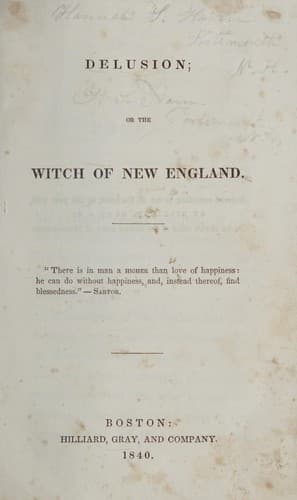
Delusion; or, The Witch of New EnglandLee, Eliza Buckminster
History
Delusion; or, The Witch of New England
Lee, Eliza Buckminster
Paranormal fiction; Salem (Mass.) -- History -- Colonial period, ca. 1600-1775 -- Fiction; Witchcraft -- New England -- Fiction
Seymore indulged himself with as many short visits to Edith as his
circumstances would allow, always struggling as he was with almost
insurmountable obstacles, and straining every nerve to attain that goal
of his hopes, a position in society that would allow him to claim his
bride. The joy that her presence imparted to his whole being, the change
that came over him the moment his weary eye caught sight of the steeple
that rose above the dear spot of all his dreams, the sunshine that she
diffused in the dark places of his mind, prevented Edith from being
sensible of the change, the painful change, that a constant struggle
with the coarse realities of his position had made in his noble nature.
She had often, indeed, said, with Jenny Deans, "It is no matter which
has the siller, if the other wants it." But Seymore's nature was proud
as well as tender.
He possessed, as we have before seen, the temperament of the poet--that
pure, rare, and passionate nature so little able to contend with the
actual difficulties of life--to whom every-day regular labor is a burden
hard to bear. We have seen that his deep religious impressions had made
him consecrate all his fine powers to the service of God; and the
tenderness of his conscience made him fear that the sacrifice was
imperfect. The conflict was ever in his soul. He was unable to satisfy
his own aspirations after a spirituality and purity, which is the slow
growth of a life of exertion. Despondency so intimately allied to the
poetic temperament produced a morbid sensibility, a sort of monomania in
his mind, having the effect of those singular mirages seen from the
sea-shore, where the most trivial and familiar objects are magnified to
temples and altars, and hung, as it were, in the clouds.
We touch with a reverend spirit and trembling hand the mysterious
influences of hidden causes, uniting with unhappy external
circumstances, to involve those who seem formed to bless and to be
blessed in a self-tormenting melancholy. I know not that, under any
circumstances, Seymore's would have been a happy spirit. Under the
present, his love for Edith seemed the only light that could save him
from total shipwreck.
The two lovers wrote to each other as often as the state of
communication between different parts of the country would allow, before
post-roads had been established, and when letters were often entrusted
to wandering Indians, and the postage paid with a little tobacco, or a
handful of meal.
We may judge of the nature of Seymore's letters by one of Edith's, which
appears to be an answer to one of his:
_October, 1692._
Public-domain text, read in full here on John Shaqi.
Reviews
Reviews
No reviews yet
Be the first to share your thoughts on this work.
Join the Discussion
Join the discussion
Sign in to leave a comment or review.
Sign InorCreate an account