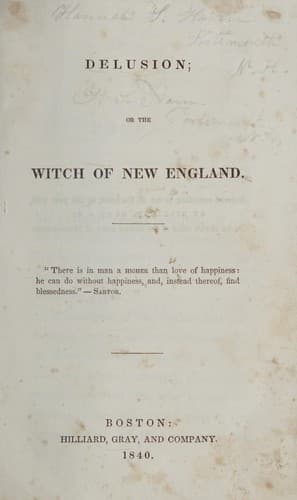
Delusion; or, The Witch of New EnglandLee, Eliza Buckminster
History
Delusion; or, The Witch of New England
Lee, Eliza Buckminster
Paranormal fiction; Salem (Mass.) -- History -- Colonial period, ca. 1600-1775 -- Fiction; Witchcraft -- New England -- Fiction
How can I be so little solitary, when I am more alone than ever? I
awake from dreams of you to feel your presence still with me; and
my first emotion is gratitude to God for having given me this
happiness. Forgive me, beloved father! that I can be so content
without you! The bonds of nature are weakened, when an absorbing
emotion fills the heart. The time may come when nature will be
avenged. Ah, it cannot be wrong to love as I do. God has opened
this fountain in the desert of life, as a solace for all its evils.
Ah, how can those who love be sufficiently grateful to God? Every
hour should be an act of adoration and praise.
You will tell me, my friend, that this all-absorbing love should
be given to God. I cannot separate God from his works. This
beautiful nature--the ocean, in all its majesty, the quiet stars,
as they seem to look down upon us, the beauty spread every where
around me--remind me always of God. I cannot represent to myself
God in his personal form: I feel him every where, and I love him
especially for having made us capable of love.
That religion should be a different thing from this pervading love
and reverence, I cannot yet understand. Faith is the gift of God;
such faith as you, my dear friend, wish me to possess; but it seems
to me, like all the other precious gifts of the soul, to be
obtained by earnest prayer and infinite strivings. When the young
man mentioned in the gospel came to our Saviour, he demanded of him
no profession of mysterious faith, but only a proof of
disinterested love.
Religion is not a distinct thing from the every-day life,
as--pardon me, my dear friend--I think you would make it. It is
like the air we breathe, requisite for a life of goodness, but not
less nor more perceptible to our well-being than the air is to our
existence. It should not make itself felt in storms and tempests,
in hot and cold fits, but in a calm and equal power, sustaining,
purifying, and nourishing our souls.
You believe the direct influence of the Spirit of God upon every
individual mind is necessary, to make him a religious being. I
cannot but think that the _indirect_ influence, the beautiful and
ever-renewed miracle of nature, the observation of God's providence
in the care of his creatures, and the study of the adaptation of
Christianity to our particular dispositions--not merely by a
process of reasoning, but aided by the religious sentiment which
seems to me innate and natural to every human being--is more
powerful.
Public-domain text, read in full here on John Shaqi.
Reviews
Reviews
No reviews yet
Be the first to share your thoughts on this work.
Join the Discussion
Join the discussion
Sign in to leave a comment or review.
Sign InorCreate an account