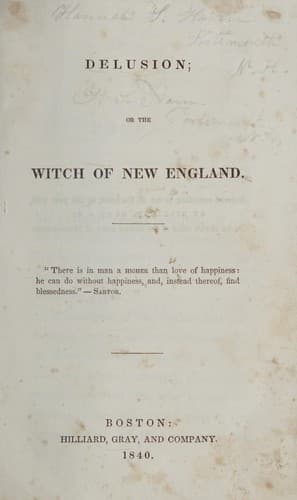
Delusion; or, The Witch of New EnglandLee, Eliza Buckminster
History
Delusion; or, The Witch of New England
Lee, Eliza Buckminster
Paranormal fiction; Salem (Mass.) -- History -- Colonial period, ca. 1600-1775 -- Fiction; Witchcraft -- New England -- Fiction
The person who had witnessed the scene with the child was the same elder
I have mentioned as possessing much tenderness of heart, but too weak a
head to listen to its dictates when opposed to the influence of others.
He had been much affected by her appeal to the child, and came back to
urge her, if she had any friends to espouse her cause, to send for them.
He said the fanaticism was increasing; that the prisons in many villages
were filled with the accused; that the hearts of the people were
hardened against them; and that her own cause had been much injured by
the confession of the old woman: and he ended by entreating her to
confess also, and save her life.
To the last proposal, Edith did not answer. She said she had already
written to the only friend on whom she could rely, and that Paul had
gone himself with her letter. Her cause, she said, seemed already lost,
and all she wished at present was, that Dinah might be permitted to
visit her, and that she might be left alone.
When Edith was alone, she felt the depression that succeeds to great
excitement. She looked back on her life with that sick and heart-broken
feeling that the young experience after severe disappointments. She was
too young to die; and, though her life had been comparatively blameless,
the excess of feeling she had lavished on a few idols seemed now to her
almost like a crime. She had forgotten, she thought, that her duties had
been plain, and simple, and humble, lying all about her path like
unnoticed flowers, while she had longed for something more exciting to
fill her heart.
It is easy for the accused to believe themselves guilty. She trembled
when she thought how many, not weaker than herself, when suspected and
deserted by friends, had yielded to their fears, and even fancied
themselves _guilty_ of crimes which they abhorred; and she mentally
prayed, "Ah, my Father, save me from myself." Then came the thought of
Seymore, of his grief, his desolation! "Ah, who will understand him,"
she said; "who will comfort him when I am gone? But will he remember
me?" thought she; "will he think of me in 'widowhood of heart?'"
Who would die and be wholly forgotten? We long intensely to live in the
hearts that love us now. We would not pass away "like the summer-dried
fountain," forgotten when its sound has ceased. We would have our lowly
grave visited by holy, twilight thoughts, and our image return at the
hour of prayer. How few are thus remembered! Now Edith thought of her
father, and all the yearning of her heart, which her love for Seymore
had stifled, came back, and torrents of tears flowed as she recalled her
happy childhood.
They were checked by the entrance of Dinah. She brought comfort with
her, and a cheerful countenance, for she did not know the result of
Edith's conversation with the child, and she was full of hope that
Phoebe would retract all she had said.
Public-domain text, read in full here on John Shaqi.
Reviews
Reviews
No reviews yet
Be the first to share your thoughts on this work.
Elsewhere in the archive
Join the Discussion
Join the discussion
Sign in to leave a comment or review.
Sign InorCreate an account