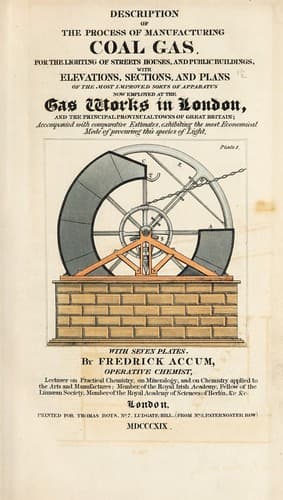
Description of the Process of Manufacturing Coal Gas, for the Lighting of Streets Houses, and Public Buildings: With Elevations, Sections, and Plans of the Most Improved Sorts of Apparatus Now Employed at the Gas Works in London and the Principal Provincial Towns of Great Britain; Accompanied With Comparative Estimates, Exhibiting the Most Economical Mode of Procuring This Species of LightAccum, Friedrich Christian
History
Description of the Process of Manufacturing Coal Gas, for the Lighting of Streets Houses, and Public Buildings: With Elevations, Sections, and Plans of the Most Improved Sorts of Apparatus Now Employed at the Gas Works in London and the Principal Provincial Towns of Great Britain; Accompanied With Comparative Estimates, Exhibiting the Most Economical Mode of Procuring This Species of Light
Accum, Friedrich Christian
Gas manufacture and works -- Great Britain; Gas-lighting
In conducting the decomposition of coal, the evolution of the gas is far
from being, with regard to quantity, uniform during different periods of
the distillatory process. The formation of the gas is more rapid in the
beginning of the process, and gradually slackens as the operation
proceeds. The gas also differs in its chemical constitution, at
different periods of the process; although in the case of large
supplies, this difference is of little consequence after the gas is
purified in the usual manner. The former consideration, however, has
given rise to various modes of operating, of which it will be proper to
take some notice.
It must be obvious, that in proportion as the mass of coal in the retort
becomes carbonized or converted into coke, the exterior surface becomes
a gradually increasing obstacle to the action of the heat upon the
interior or central part of the coal remaining to be decomposed. The
heat required on that account must be more intense, and kept up to no
purpose, and the extrication of gas becomes slower and slower, as the
operation proceeds.
The loss occasioned by this rapid diminution of the means employed, is
serious in every point of view, in regard as well to the quantity of
fuel used and time wasted, but it is unavoidable in the operation of
decomposing coal in masses or layers from 5 to 10 inches in thickness,
and must be a great drawback on the value of the gas-light discovery.
The loss of fuel, it is obvious, must be just in proportion to the
quantity of carbonised matter, or coke, which is kept hot to no purpose,
awaiting the decomposition of that portion of coal, which it is the
very means of protecting from becoming decomposed.
A striking exemplification of this statement will be seen in the
following table, exhibiting the result of the progressive produce of
coal gas, obtainable, in a given time, by means of cylindrical and
parallelopipedal retorts.
_Experiment with one cylindrical Retort, containing two bushels of
coal._
Hours of the Quantity of Gas
distillatory process produced.
First hour 115 cubic feet
Second ditto 81 ditto
Third ditto 78 ditto
Fourth ditto 70 ditto
Fifth ditto 66 ditto
Sixth ditto 55 ditto
Seventh ditto 49 ditto
Eighth ditto 42 ditto
---
555 cubic feet.
The quantity of gas is at the rate of ten thousand cubic feet to the
chaldron (27 cwt.) of coal.
_Experiment[14] with eighteen cylindrical Retorts, containing one
chaldron of coal._
Hours of the Quantity of gas
distillatory process produced.
Reviews
Reviews
No reviews yet
Be the first to share your thoughts on this work.
Join the Discussion
Join the discussion
Sign in to leave a comment or review.
Sign InorCreate an account