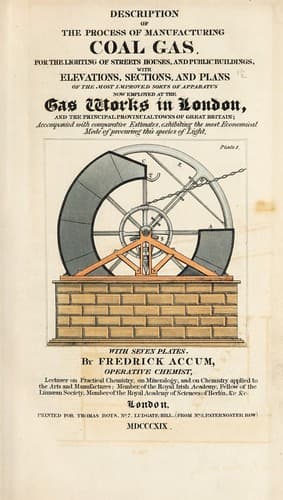
Description of the Process of Manufacturing Coal Gas, for the Lighting of Streets Houses, and Public Buildings: With Elevations, Sections, and Plans of the Most Improved Sorts of Apparatus Now Employed at the Gas Works in London and the Principal Provincial Towns of Great Britain; Accompanied With Comparative Estimates, Exhibiting the Most Economical Mode of Procuring This Species of LightAccum, Friedrich Christian
History
Description of the Process of Manufacturing Coal Gas, for the Lighting of Streets Houses, and Public Buildings: With Elevations, Sections, and Plans of the Most Improved Sorts of Apparatus Now Employed at the Gas Works in London and the Principal Provincial Towns of Great Britain; Accompanied With Comparative Estimates, Exhibiting the Most Economical Mode of Procuring This Species of Light
Accum, Friedrich Christian
Gas manufacture and works -- Great Britain; Gas-lighting
It is essential that the condensation of the vaporous fluids should be
fully completed before they reach the tar cistern. To effect this, there
is usually allowed a considerable distance to intervene between the
discharging pipe K, fig. 1, plate V., and the reservoir destined to
receive the condensible products; or the pipe is made to pass through a
vessel containing water, called the condenser, which acts in a similar
manner as the refrigeratory of a common still. It is obvious that it is
immaterial how the condensation of the vaporous fluid is effected; it is
essential, however, that the condensation should be complete before the
liquid tar and ammoniacal fluid reach the reservoir destined to receive
these products.
The gaseous fluid which accompanies the condensible products, are then
made to pass into the lime machine, of which we shall speak hereafter,
in order to be deprived by means of quick-lime and water, from the
portion of sulphuretted hydrogen and carbonic acid gas which was
combined with the gas. And when this has been accomplished, the purified
gas is conveyed into the gas-holder, where it is stored up for use. This
part of the operation will be rendered more obvious hereafter. In some
establishments, the hydraulic main is furnished with two discharging
pipes, the one carries away the condensible fluid, into which the
perpendicular pipes P, fig. 2, plate IV. dip, whilst the other serves to
convey away the gaseous fluids to a condensor, in order to deposit the
vaporous portion of condensible liquid it may contain, and from thence
the gas passes into the purifying apparatus, or lime machine. X, fig. 2,
plate IV., is a small screw plug, which, when opened, restores the
equilibrium of the air within and without the retort previous to the lid
being taken off, to prevent the loud report, which otherwise happens
when the lid or cover of the retort is suddenly removed. To avoid these
explosive reports which had become a nuisance to the neighbourhood of
gas works, the practice of gradually withdrawing the lid of the retort,
and at the same time presenting a lighted torch has been adopted at some
works, which fully remedies the evil.
The number of retort ovens at the Westminster Chartered Gas Works’
Stations, amounts to four hundred and ninety.
PART V.
_Difference in the quantity of Gas evolved during different periods of
the distillatory process, and economical considerations resulting
therefrom in the manufacture of Coal Gas._
Public-domain text, read in full here on John Shaqi.
Reviews
Reviews
No reviews yet
Be the first to share your thoughts on this work.
Join the Discussion
Join the discussion
Sign in to leave a comment or review.
Sign InorCreate an account