Development of Muslim Theology, Jurisprudence, and Constitutional Theory — John Shaqi
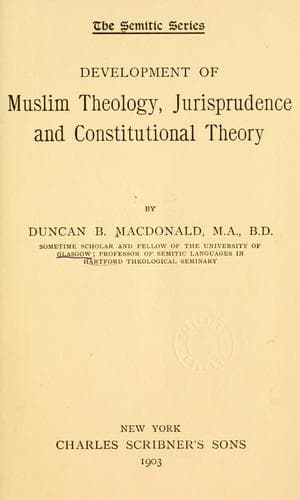
Development of Muslim Theology, Jurisprudence, and Constitutional TheoryMacDonald, Duncan Black
ReligionIslamic
Development of Muslim Theology, Jurisprudence, and Constitutional Theory
MacDonald, Duncan Black
Constitutional law (Islamic law); Islam -- Doctrines -- History; Islam and state -- History; Islamic law -- History
found it prudent to have himself crowned by Pius VII.
[Sidenote: SOVEREIGNTY OF KHALIFATE]
But a wave was soon to break in and sweep away all these forms. It came
with the Mongols under Hulagu, who passed from the destruction of the
Assassins to the destruction of Baghdad and the Khalifate. In A.H. 656
(A.D. 1258), the city was taken and the end of the Abbasids had come. An
uncle of the reigning Khalifa escaped and fled to Egypt, where the Mamluk
Sultan received him and gave him a spiritual court and ecclesiastical
recognition. He found it good to have a Khalifa of his own to use in
any question of legitimacy. The name had yet so much value. Finally, in
1517, the Mamluk rule went down before the Ottoman Turks, and the story
told by them is that the last Abbasid, when he died in 1538, gave over
his rights to their Sultan, Sulayman the Great. Since then, the Ottoman
Sultan of Constantinople has claimed to be the Khalifa of Muhammad and
the spiritual head of the Muslim world.
Such were the fates of the Commanders of the Faithful. We have traced
them through a long and devious course, full of confusions and
complications. Leaving aside the legitimist party, the whole may be
summed in a word. The theoretical position was that the Imam, or leader,
must be elected by the Muslim community, and that position has never,
theoretically, been abandoned. Each new Ottoman sovereign is solemnly
elected by the Ulama, or canon lawyers and divines of Constantinople.
His temporal sovereignty comes by blood; in bestowing this spiritual
sovereignty the Ulama act as representatives of the People of Muhammad.
Thus the theoretical position was liable to much modification in
practice. The Muslim community resolves itself into the people of the
capital; still further, into the body-guard of the dead Khalifa; and,
finally, as now, into the peculiar custodians of the Faith. Among the
Ibadites the position from the first seems to have been that only those
learned in the law should act as electors. Along with this, the doctrine
developed that it was the duty of the people to recognize _un fait
accompli_ and to do homage to a successful usurper—until another more
successful should appear. They had learned that it was better to have
a bad ruler than no ruler at all. This was the end of the democracy of
Islam.
[Sidenote: CONSTITUTIONAL QUESTION OF TO-DAY]
Public-domain text, read in full here on John Shaqi.
Reviews
Reviews
No reviews yet
Be the first to share your thoughts on this work.
Join the Discussion
Join the discussion
Sign in to leave a comment or review.
Sign InorCreate an account